Best Books for JLPT N1: A Structured Guide for Your Foundation
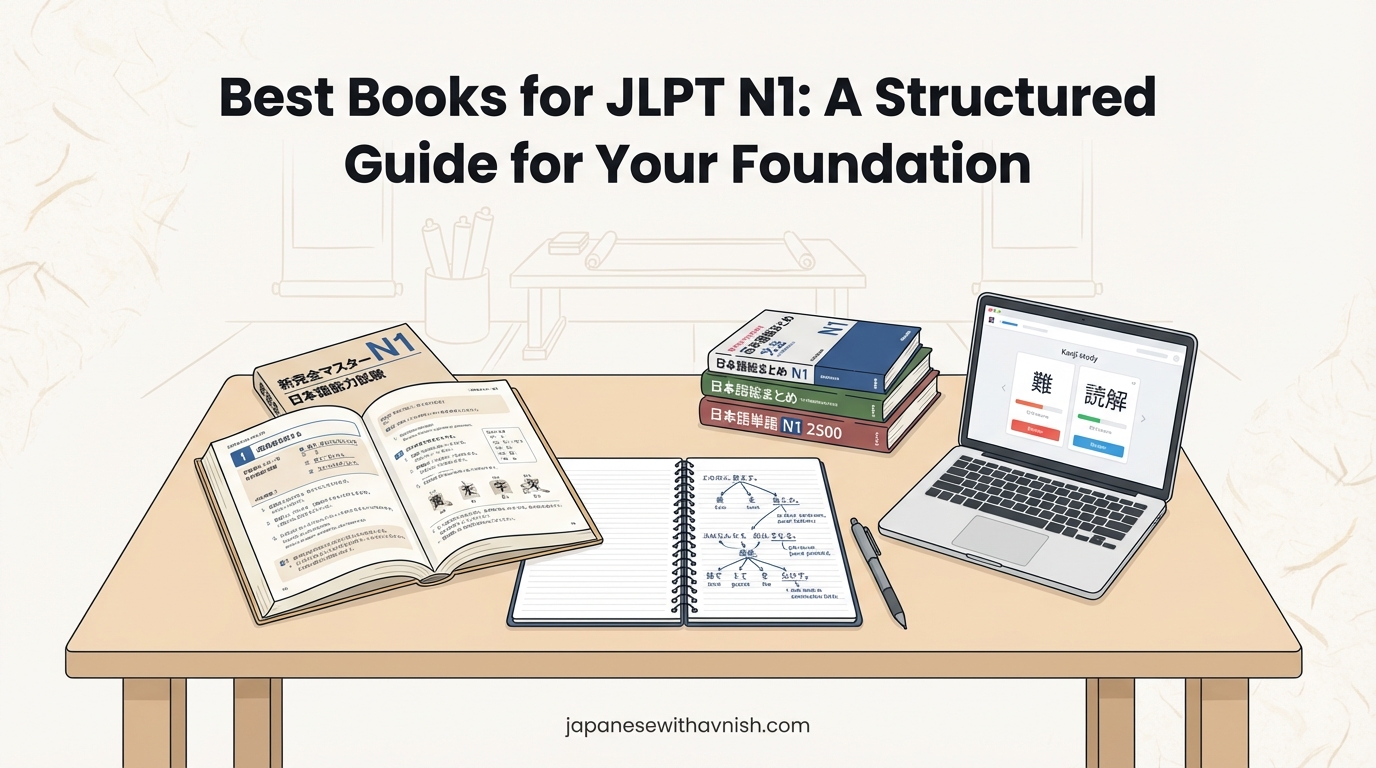
Best Books for JLPT N1: A Structured Guide for Your Foundation
Reaching the JLPT N1 level is a significant academic and personal achievement, representing a profound understanding of the Japanese language. It signifies the ability to comprehend complex texts, follow abstract discussions, and express nuanced ideas—a level of proficiency that opens doors to advanced academic research, professional opportunities, and a deeper cultural connection. However, the journey from N2 to N1 is often described as the most challenging leap, not merely due to the volume of new material, but because of the depth of comprehension required. The sheer number of available textbooks, grammar guides, and kanji dictionaries can be overwhelming, leading to inefficient study and frustration.
This guide is designed to provide calm, structured clarity. We will move beyond simple book lists to present a foundational framework for your N1 preparation. By understanding the core competencies tested and selecting resources that build upon each other systematically, you can transform this daunting task into a manageable and intellectually rewarding process. Let us build a solid foundation for your success.
Table of Contents
- Understanding the JLPT N1 Challenge: Beyond Vocabulary Lists
- The Core Philosophy: Building a Four-Pillar Foundation
- Pillar 1: Mastering Advanced Grammar and Sentence Patterns
- Pillar 2: Expanding Your Lexicon: Vocabulary and Kanji
- Pillar 3: Developing Superior Reading Comprehension
- Pillar 4: Honing Listening Skills for Natural Speech
- Integrating Your Resources: A Sample 6-Month Study Framework
- Final Recommendations and Next Steps
Understanding the JLPT N1 Challenge: Beyond Vocabulary Lists
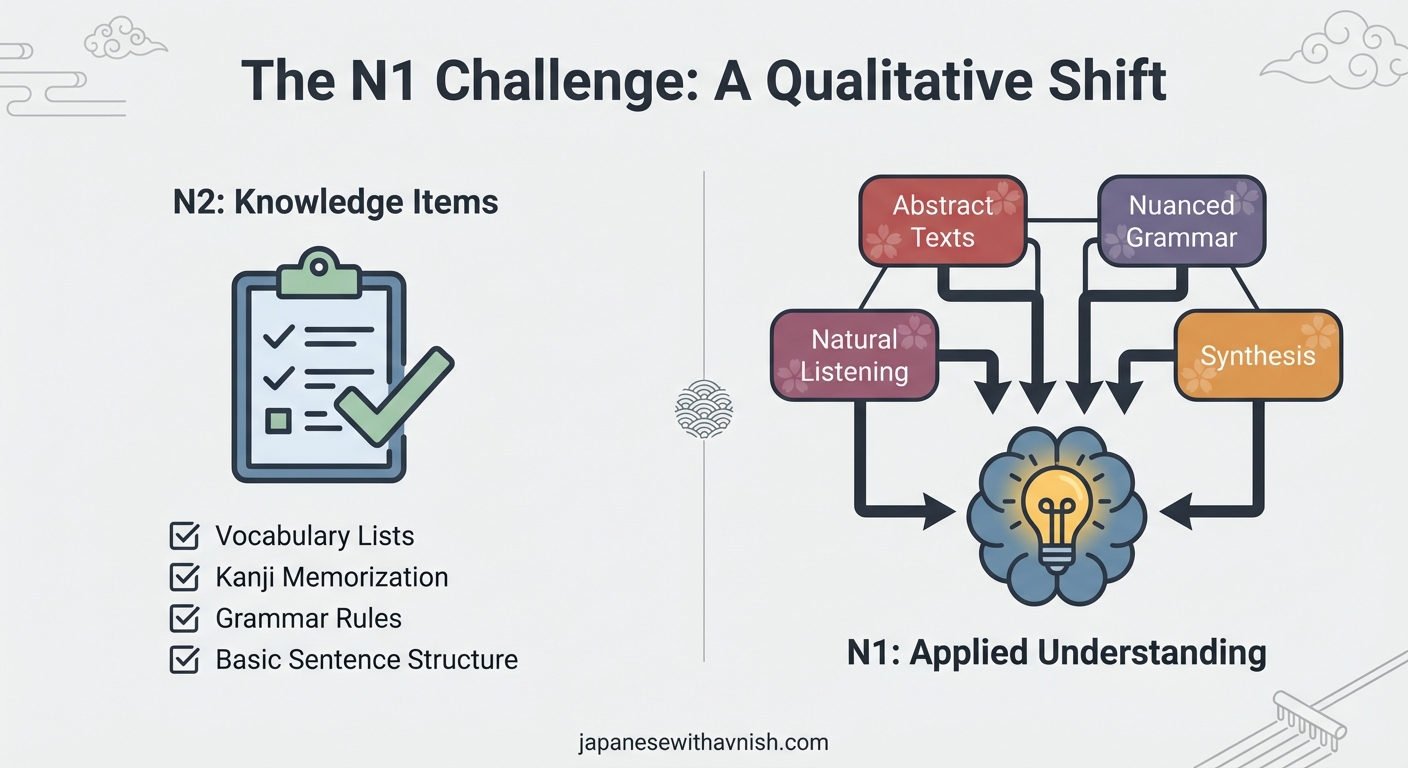
The JLPT N1 is not simply an extension of N2; it is a qualitative shift. The exam assesses your ability to use Japanese in real-world, complex situations. You will encounter:
- Abstract and Logical Texts: Editorials, critical essays, and academic papers where the author's opinion and logical flow (論理展開, ronri tenkai) are paramount.
- Nuanced Grammar: Expressions that convey subtle differences in perspective, such as ~に即して (in accordance with) versus ~に沿って (along the lines of), or the use of classical Japanese-derived patterns like ~べく (in order to).
- High-Speed, Natural Listening: Conversations and news reports featuring rapid speech, elliptical expressions, and background noise, requiring inference and prediction.
- Synthesized Information: Questions that require you to compare and contrast information from multiple sources, such as different reviews of a product or opposing viewpoints in a debate.
Therefore, your book selection must support this shift from "learning items" to "applying understanding."
The Core Philosophy: Building a Four-Pillar Foundation
A successful N1 strategy rests on four interdependent pillars: Grammar, Vocabulary/Kanji, Reading, and Listening. Your resources should address each pillar with materials that progress from explicit learning to implicit application.
- Explicit Learning Books: These are your reference texts and drills (e.g., Shin Kanzen Master series, Sou Matome series). They break down rules, list vocabulary, and provide focused practice.
- Implicit Application Books: These are your simulation and immersion tools (e.g., past exam papers, newspaper readers, podcast transcripts). They force you to use your knowledge in context, under time pressure.
A balanced study plan strategically uses both types.
Pillar 1: Mastering Advanced Grammar and Sentence Patterns
Your grammar resource must do more than list patterns; it must explain nuance, usage, and formality.
Primary Recommendation: 新完全マスター文法 日本語能力試験N1 (Shin Kanzen Master Bunpou N1) This book is unparalleled for depth. It groups grammar points by function (e.g., "Expressing Cause and Reason," "Adding Information") rather than alphabetically, helping you understand when and why to use a particular expression. Each point includes clear explanations in Japanese, multiple example sentences, and practice questions that mimic the exam format.
- Example: To express "from the standpoint of..."
- ~上で (~うえで): Used for practical, procedural standpoints. 契約書にサインする上で、注意すべき点を説明します。 (I will explain points to note from the standpoint of signing the contract.)
- ~上は (~うえは): Used once a decision or situation is set, meaning "now that..." 引き受けた上は、最後まで責任を持ちます。 (Now that I have accepted, I will take responsibility to the end.)
The book drills these subtle distinctions.
Supplementary Resource: 日本語総まとめ N1 文法 (Sou Matome N1 Grammar) This series offers a more paced, 6-week format. It is excellent for an initial overview or review, presenting a manageable amount of material per day. Its explanations are slightly simpler than Shin Kanzen Master, making it a good entry point before tackling the more detailed text.
Pillar 2: Expanding Your Lexicon: Vocabulary and Kanji
At N1, you must recognize approximately 10,000 vocabulary items and 2,000 kanji. The key is learning words in thematic and contextual clusters.
Primary Recommendation: 新完全マスター語彙 日本語能力試験N1 (Shin Kanzen Master Goi N1) This book organizes vocabulary by topic (社会、経済、科学) and by word type (複合語、カタカナ語). This thematic approach mirrors how you encounter language in reading and listening. It includes exercises that test synonyms, antonyms, and usage in context.
For Kanji: 新完全マスター漢字 日本語能力試験N1 (Shin Kanzen Master Kanji N1) It focuses on kanji as they appear in compound words (熟語, jukugo) relevant to N1, rather than isolated characters. Learning 経済 (economy), 経営 (management), and 経験 (experience) together is more effective than studying the character 経 in isolation.
Essential Tool: A Japanese-Japanese Dictionary Begin transitioning from a bilingual to a monolingual dictionary like 新明解国語辞典 or using digital versions. This practice is crucial for understanding precise definitions and nuances that translation cannot capture.
Pillar 3: Developing Superior Reading Comprehension
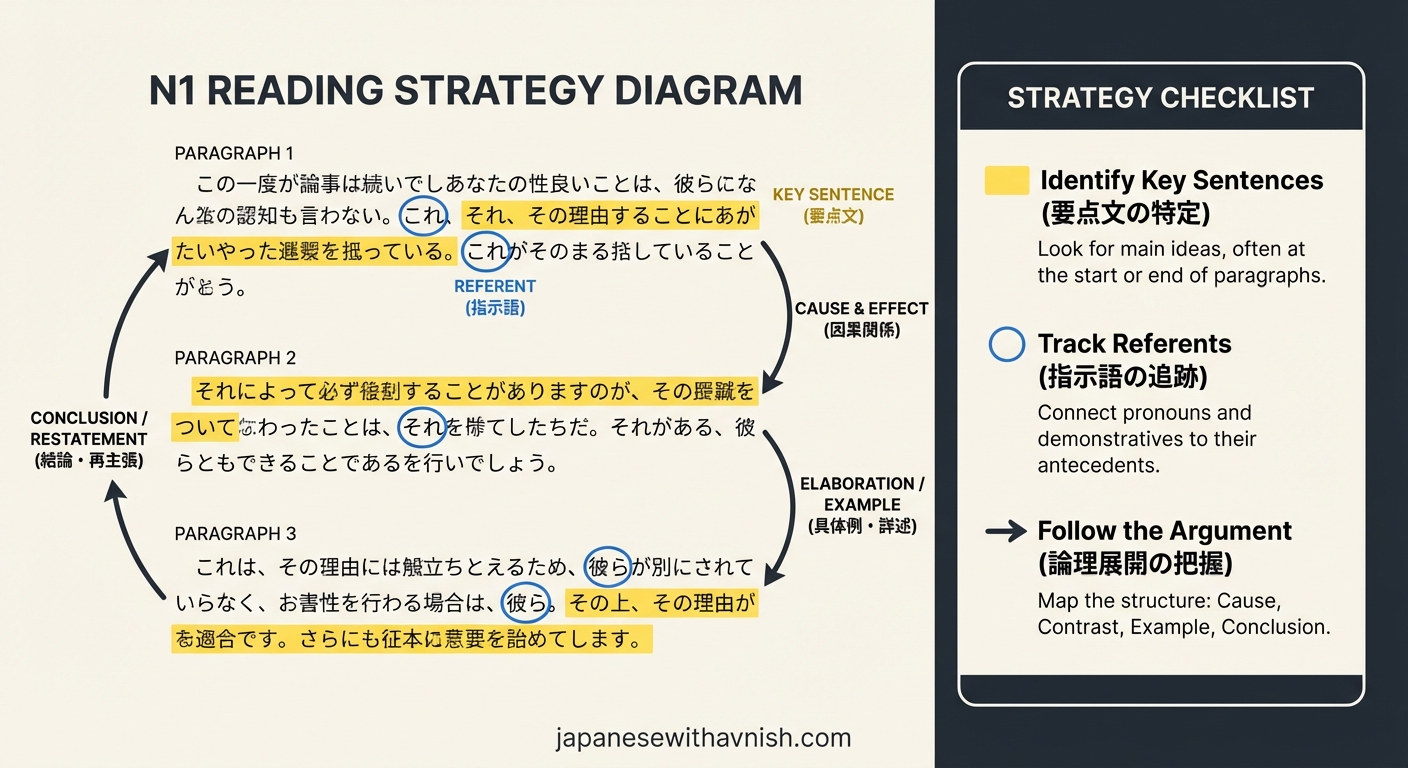
N1 reading requires speed, accuracy, and the ability to grasp logical structure.
Primary Recommendation: 新完全マスター読解 日本語能力試験N1 (Shin Kanzen Master Dokkai N1) This book is a masterclass in reading strategy. It teaches you how to identify key sentences (要点文), understand referents (指示語), and follow the author's argument. The passages increase in difficulty and cover a wide range of genres.
For Application: 日本語能力試験 公式問題集 N1 (JLPT Official Practice Workbook N1) Nothing replicates the exam like the official questions. Use this book for timed practice sessions to build stamina and accuracy.
Immersion Suggestion: Newspaper Readers & Editorials Resources like Asahi Shinbun's "Editorial with English Translation" or books of collected essays (文庫本, bunkobon) on social issues provide authentic material. The goal is not to understand every word, but to follow arguments and identify common rhetorical structures.
Pillar 4: Honing Listening Skills for Natural Speech
N1 listening features natural speed, elliptical speech, and a variety of accents.
Primary Recommendation: 新完全マスター聴解 日本語能力試験N1 (Shin Kanzen Master Choukai N1) Its strength lies in teaching you how to listen. It provides strategies for predicting content from visuals, noting key information, and distinguishing between similar-sounding responses. The scripts are included for thorough review.
For Immersion: NHK News Web Easy & Podcasts Start with NHK News Web Easy, then graduate to regular NHK news podcasts. Listen actively: first for gist, then for detail, and finally, transcribe short segments to catch particles and conjugations you might miss.
Integrating Your Resources: A Sample 6-Month Study Framework
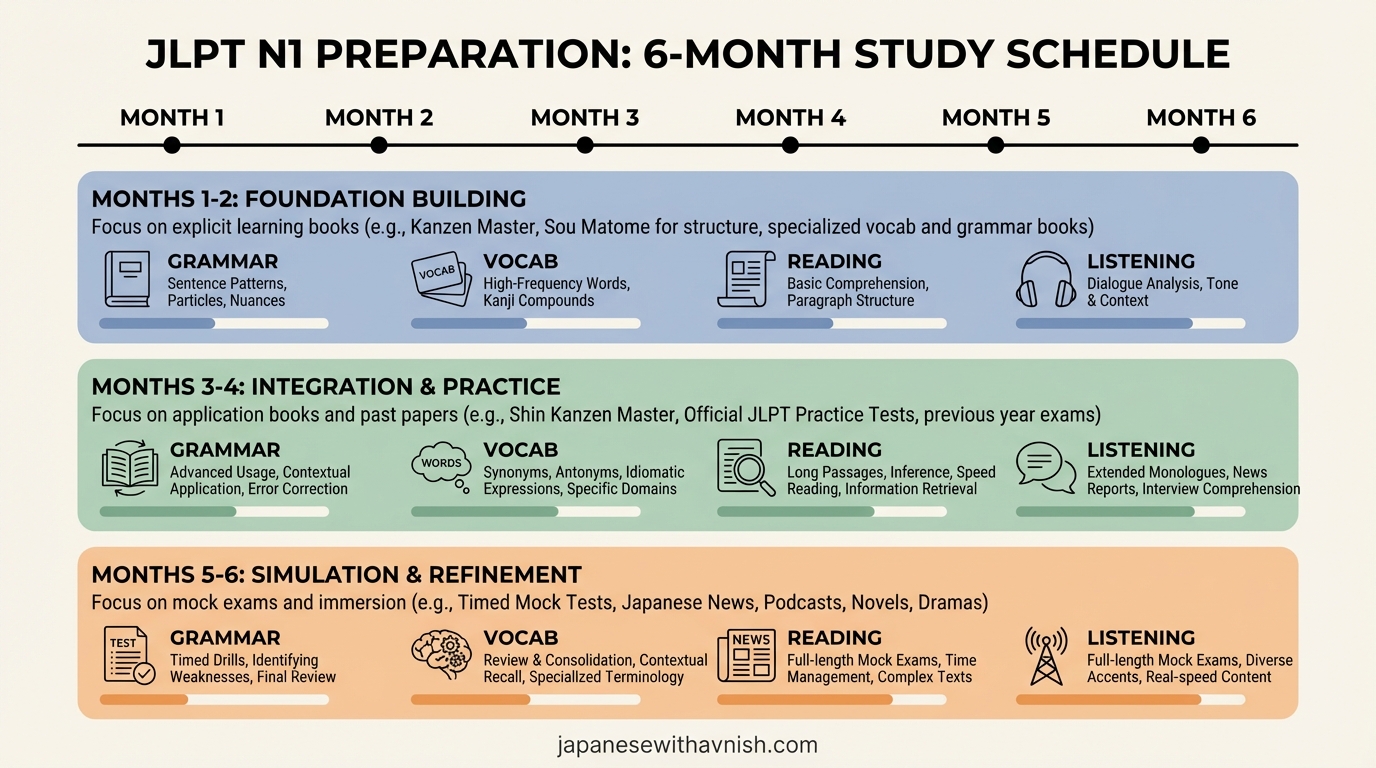
A structured approach prevents burnout and ensures all pillars are addressed. Here is a condensed framework:
Months 1-2: Foundation Building
- Focus: Explicit learning from Sou Matome or Shin Kanzen Master series.
- Daily: 1 grammar point, 1 page of vocabulary/kanji, 1 short reading passage, 1 listening exercise.
- Weekly: Review all material from the week; write short sentences using new grammar/vocab.
Months 3-4: Integration & Practice
- Focus: Shift to Shin Kanzen Master application books and begin past papers.
- Daily: Timed reading drills (20 mins), focused listening practice with transcription.
- Weekly: One full section (e.g., Language Knowledge) from a past paper under timed conditions.
Months 5-6: Simulation & Refinement
- Focus: Full-length mock exams and targeted weakness repair.
- Bi-weekly: Take a full, timed practice test from the Official Practice Workbook.
- Analysis: Meticulously review every mistake. Was it a knowledge gap (return to Pillar 1/2 books) or an application error (do more Pillar 3/4 drills)?
- Immersion: Increase daily exposure to authentic materials (news, articles, podcasts).
Final Recommendations and Next Steps
Building your N1 library is an investment. Start with one core series—either Shin Kanzen Master (for depth) or Sou Matome (for a structured pace)—for Grammar, Vocabulary, and Listening. Add the Official Practice Workbook for authentic test practice. As you progress, incorporate the Reading comprehension book and authentic materials.
Remember, consistency over intensity is key. Studying 60 minutes daily with clear goals is far more effective than an unstructured 5-hour session once a week.
If you prefer a fully integrated, structured study system that eliminates the guesswork of resource selection and scheduling, consider our Japanese N1 Elite Bundle. It is designed to provide a coherent, step-by-step pathway through the N1 curriculum, integrating focused lessons, progressive drills, and simulated practice to build the robust, four-pillar foundation required for success.
Summary
Reaching the JLPT N1 level represents a profound shift from intermediate to advanced proficiency, requiring the ability to navigate abstract texts, nuanced grammar, and natural, high-speed speech. This guide moves beyond a simple book list to offer a structured, four-pillar framework for effective study, emphasizing the transition from explicit learning to implicit application. The foundation rests on mastering Advanced Grammar, expanding Vocabulary/Kanji, developing superior Reading Comprehension, and honing Listening skills. For each pillar, specific resources are recommended. The *Shin Kanzen Master* series is highlighted for its depth, particularly its grammar book which groups points by function to clarify subtle nuances. The *Sou Matome* series offers a more paced, six-week format suitable for initial review. For vocabulary and kanji, a thematic approach is advised, using resources like *Shin Kanzen Master Goi N1* to learn words in contextual clusters. Developing reading proficiency requires strategic practice with books like *Shin Kanzen Master Dokkai N1* and authentic materials like newspaper editorials. Listening skills are best honed with focused strategy books and immersion through NHK news and podcasts. A sample six-month study framework illustrates how to integrate these resources systematically, progressing from foundational learning to full exam simulation. The key takeaway is the importance of a balanced, consistent approach using both dedicated study texts and authentic application materials. The guide concludes by recommending starting with a core series and the official practice workbook, stressing that daily, structured study is more effective than sporadic cramming.
What should you do next?
Recommended next reads
JLPT N1 90-Day Study Plan: A Day-by-Day Guide
A detailed 90-day study plan for the JLPT N1 exam. Includes daily goals, study schedules, and resources to help you pass the N1.
JLPT N1 Roadmap: Your Structured Guide to Success
A structured, step-by-step guide to mastering the JLPT N1 exam. Covers study phases, resource recommendations, and strategies for vocabulary, grammar, reading, and listening.
Comments
Add a comment
Recommended bundles for you
Structured study materials to accelerate your JLPT journey.