JLPT N1 Roadmap: Your Structured Guide to Success
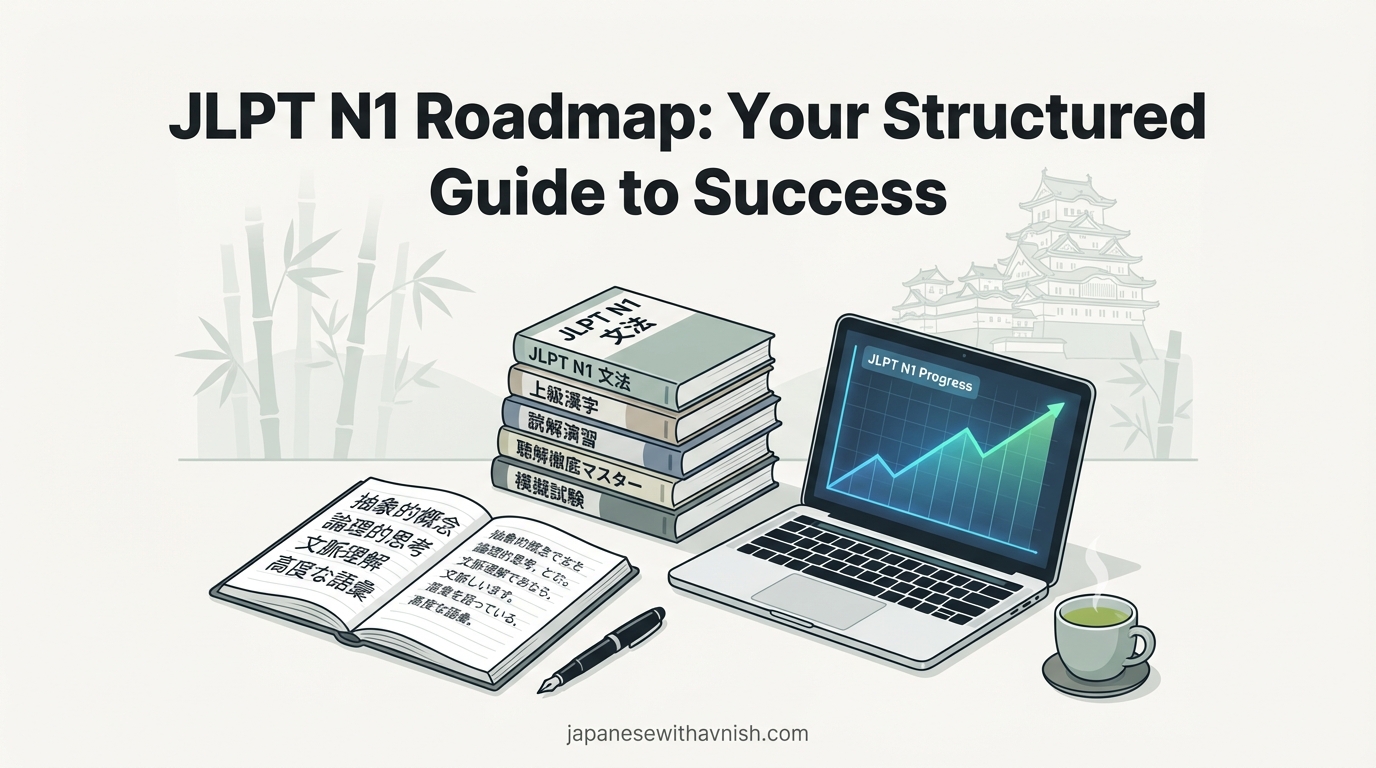
JLPT N1 Roadmap: Your Structured Guide to Success
Reaching for the JLPT N1 is a commendable and ambitious goal. It represents the pinnacle of standardized Japanese language proficiency, a level signifying near-native comprehension and the ability to navigate complex social, academic, and professional situations. For many learners, the journey can feel daunting, a vast landscape of advanced grammar, nuanced vocabulary, and abstract reading passages. However, the key to conquering this summit is not just hard work, but structured, intelligent preparation. This guide provides a calm, clear, and actionable roadmap to transform the challenge of JLPT N1 into a manageable, systematic process. By breaking down the exam, outlining a phased study plan, and recommending effective strategies, we aim to provide the clarity and confidence needed for your success.
Table of Contents
- Understanding the JLPT N1 Exam Structure
- The Four Pillars of N1 Preparation
- Phase 1: Foundation Assessment & Resource Gathering (Months 1-2)
- Phase 2: Core Knowledge Acquisition (Months 3-6)
- Phase 3: Integration & Applied Practice (Months 7-9)
- Phase 4: Final Review & Test Simulation (Months 10-12)
- Recommended Resources and Study Tools
- Maintaining Momentum and Mindset
Understanding the JLPT N1 Exam Structure
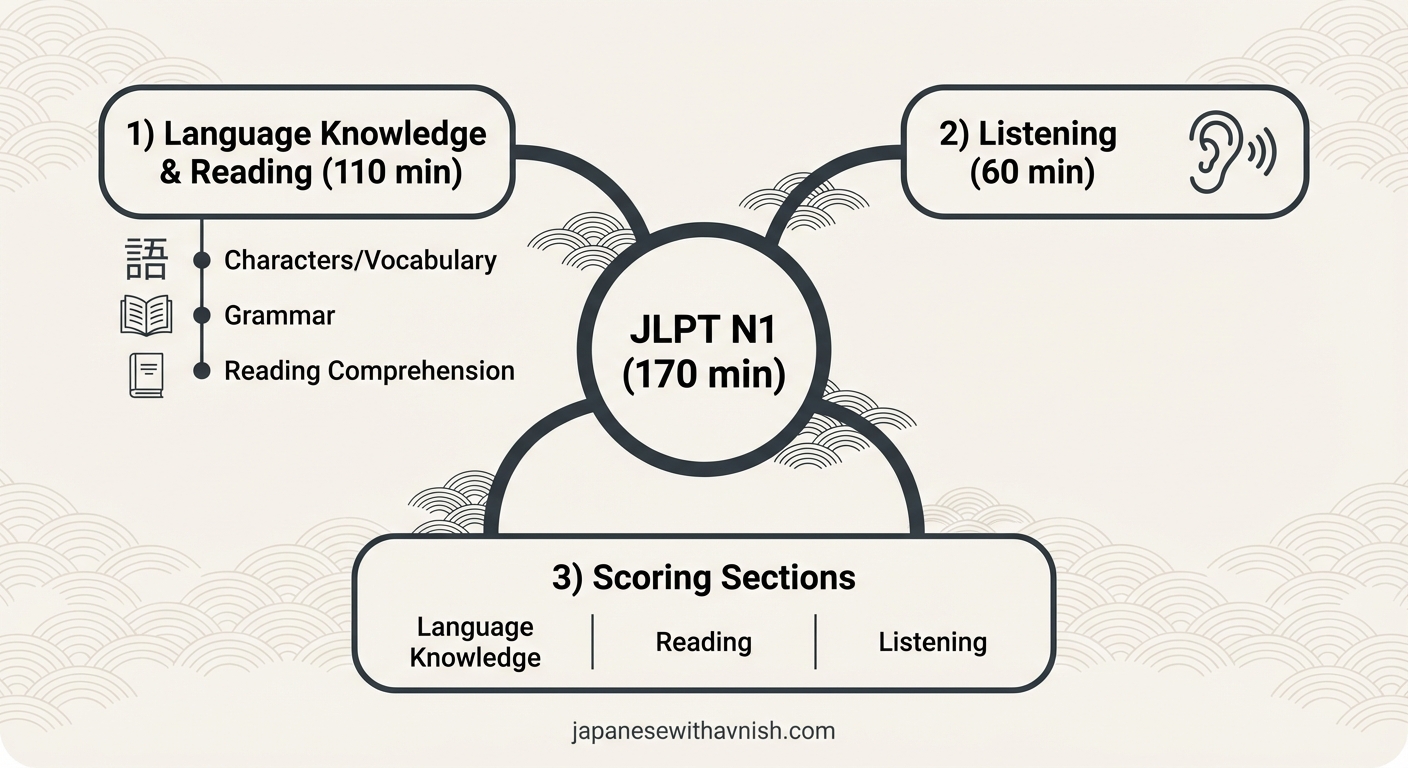
A strategic approach begins with knowing exactly what you are facing. The JLPT N1 is divided into three main sections, testing language knowledge, reading, and listening in an integrated manner. Unlike lower levels, N1 demands not just understanding, but analysis, inference, and synthesis of information.
-
言語知識 (げんごちしき - Gengo Chishiki) - Language Knowledge & Reading (110 minutes): This combined section is the longest and most demanding.
- 文字・語彙 (もじ・ごい - Moji・Goi): Tests knowledge of kanji readings (especially complex 熟語 - jukugo) and advanced vocabulary, including synonyms, antonyms, and appropriate usage in context. Example: 彼の意見は会議を活発化させた。(Kare no iken wa kaigi o kappatsuka saseta.) - His opinion enlivened the discussion.
- 文法 (ぶんぽう - Bunpou): Focuses on high-level grammatical patterns, sentence composition (ordering sentences to form a coherent paragraph), and text grammar (choosing the correct phrase to insert into a passage).
- 読解 (どっかい - Dokkai): Includes complex, lengthy passages from editorials, critiques, and academic texts. Questions test for comprehension of main arguments, detailed information, author's intent, and the ability to infer meaning.
-
聴解 (ちょうかい - Choukai) - Listening (60 minutes): The listening section features natural-speed conversations, news reports, and monologues on abstract topics. Key skills include understanding the gist, specific details, speaker's intent, and the ability to follow the logical flow of a discussion.
The Four Pillars of N1 Preparation
Success at N1 rests on the balanced development of four interconnected pillars:
- Advanced Vocabulary (語彙力 - Goiryoku): Moving beyond daily use to academic, business, and literary terms. Focus on 熟語 (jukugo - compound kanji words) and nuanced synonyms.
- Complex Grammar (文法力 - Bunpouryoku): Mastering patterns that express subtlety, hypothesis, concession, and abstract relations (e.g., ~ばこそ, ~ないまでも, ~といえども).
- Critical Reading (読解力 - Dokkairyoku): The ability to deconstruct long, dense texts, identify rhetorical structures, and infer unstated opinions.
- Analytical Listening (聴解力 - Choukairyoku): Comprehending extended spoken discourse where the key information is implied or spread throughout the dialogue.
Neglecting any one pillar will create a weakness the exam will inevitably expose.
Phase 1: Foundation Assessment & Resource Gathering (Months 1-2)
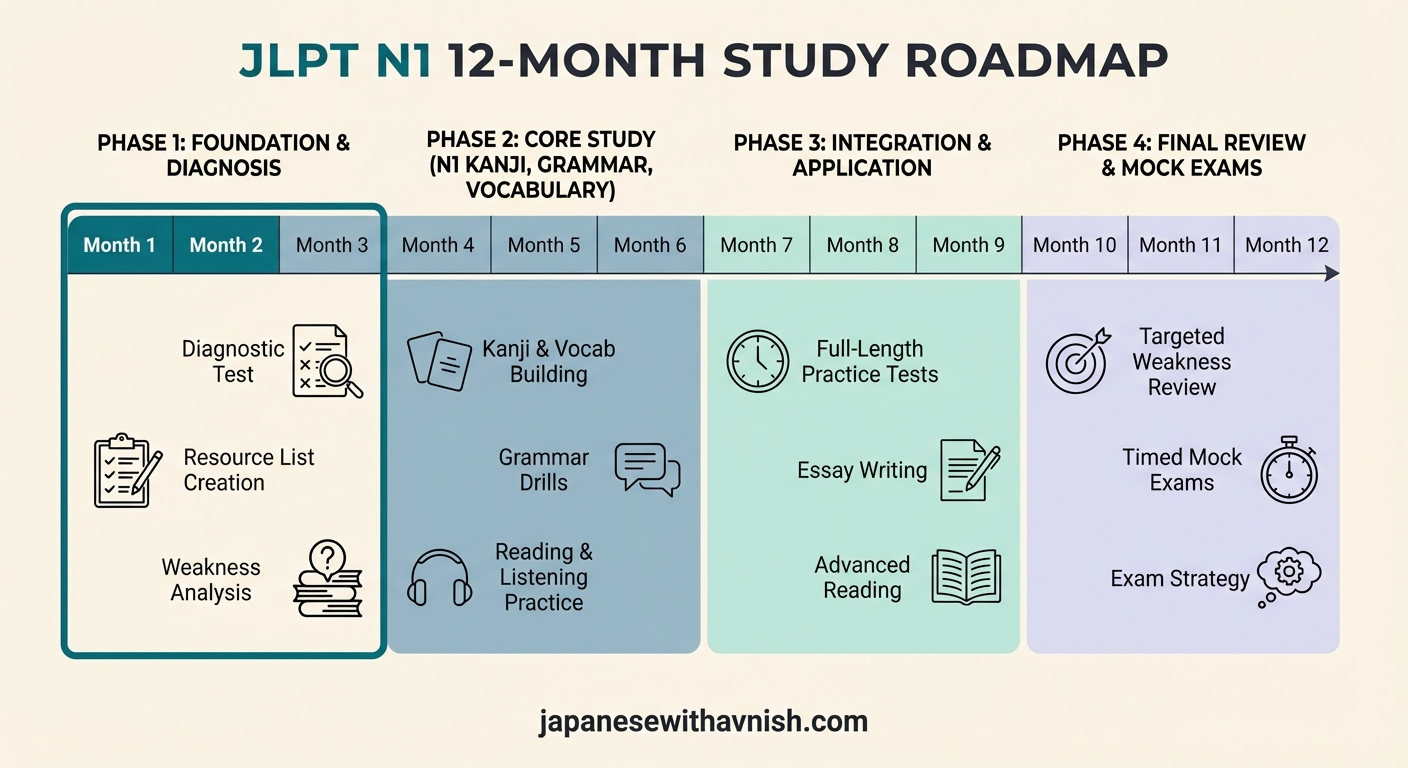
Begin not with blind study, but with honest assessment. Take one full, timed N1 practice test under exam conditions. This diagnostic is not to demoralize you, but to provide a precise map of your strengths and weaknesses across the four pillars. Analyze the results: Is vocabulary your bottleneck? Do long reading passages consume all your time? Does fast, natural listening leave you behind?
Concurrently, gather your core resources. You will need:
- A dedicated N1 grammar guide (e.g., Shin Kanzen Master, Sou Matome).
- An N1 vocabulary book and associated flashcards (digital or physical).
- An N1 kanji reference, though at this level, kanji is best studied integrated with vocabulary.
- Graded readers or authentic materials (news articles, essays, short stories).
- JLPT N1 past papers or high-quality mock tests (at least 5-7 sets).
For learners seeking a fully integrated system that consolidates these elements into a coherent study plan, our Japanese N1 Elite Bundle provides a structured curriculum covering all four pillars with targeted lessons, practice, and audio drills.
Phase 2: Core Knowledge Acquisition (Months 3-6)
This is the intensive learning phase. Structure your weekly study to rotate through the pillars.
- Vocabulary/Kanji: Aim for 15-20 new words daily. Use sentences, not just definitions. Example: Learn 顕著 (けんちょ - kencho, conspicuous) via: 技術の進歩による変化が顕著だ。(Gijutsu no shinpo ni yoru henka ga kencho da.)
- Grammar: Study 3-5 new grammar points per week. Create your own example sentences for each. Focus on the nuance and connective function.
- Reading: Daily practice is non-negotiable. Start with shorter editorials (e.g., NHK News Web Easy's standard articles, Asahi/Tomiuri editorials). Read once for gist, then again to analyze sentence structure and look up unknown patterns.
- Listening: Immerse daily. Use podcasts, news audio (NHK Radio News), and drama/anime without subtitles for gist practice. Use textbook listening exercises for detailed, question-focused practice.
Phase 3: Integration & Applied Practice (Months 7-9)
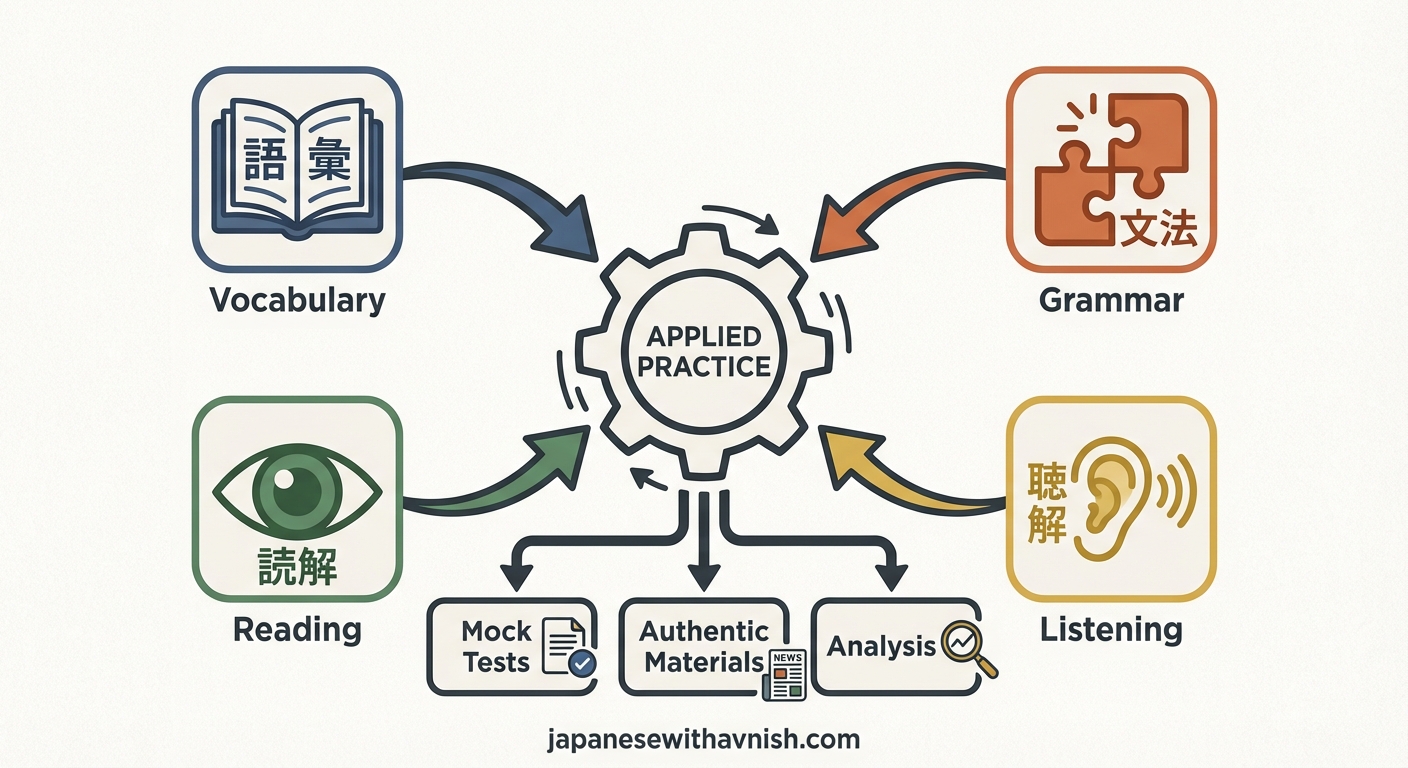
Shift from learning discrete points to applying them. Begin doing partial practice tests—complete just the reading section in 70 minutes, or just the listening. Analyze every mistake deeply: Was it a vocabulary gap? A misread grammar pattern? A logical error in inference?
Start integrating authentic materials more heavily. Read a full opinion piece and summarize its argument in Japanese. Listen to a podcast and try to transcribe a 30-second segment. This phase builds the stamina and fluidity required for N1.
Focus on speed and accuracy in the Language Knowledge section. Drills for vocabulary and grammar should become rapid-fire.
Phase 4: Final Review & Test Simulation (Months 10-12)
The final quarter is for consolidation and conditioning. Schedule a full mock exam every other weekend under strict timing. Use the interim week to review every incorrect answer from the previous mock, revisiting the relevant vocabulary, grammar, or reading/listening strategy.
Create summary sheets for grammar patterns you consistently forget. Review your accumulated vocabulary flashcards. Refine your test-taking strategy: Know which question types to tackle first, how to pace yourself in reading, and how to manage energy during the long test.
Recommended Resources and Study Tools
- Official JLPT Resources: The official website offers sample questions and a rough score guide.
- Comprehensive Textbooks: Series like Shin Kanzen Master are renowned for their depth and practice quality.
- Digital Tools: Use SRS apps (Anki) for vocabulary. Utilize browser extensions (Rikaikun/Chan) for seamless reading of online Japanese texts.
- Authentic Input: Subscribe to Japanese news podcasts (例えば、「NHKニュース」), follow Japanese intellectuals on social media, or read non-fiction books in your field of interest.
- Structured Systems: For a guided path that removes the guesswork from planning, consider our Complete Japanese N5-N1 Mega Bundle, which offers a seamless progression from foundational to advanced mastery, ensuring no gaps in your knowledge as you approach N1.
Maintaining Momentum and Mindset
The N1 journey is a marathon. Consistency trumps cramming. Establish a non-negotiable daily study ritual, even if only 60-90 minutes. Celebrate small victories—mastering a difficult text, recognizing a grammar pattern in the wild. Connect with other N1 aspirants for support. Remember, the goal is not just to pass a test, but to genuinely elevate your Japanese to a level of sophisticated understanding. The discipline and skills honed during this preparation will serve you far beyond the examination hall.
If you prefer a structured, ready-made study system that meticulously addresses the advanced demands of the JLPT N1, explore our Japanese N1 Elite Bundle. Designed for serious learners, it provides a clear curriculum integrating advanced grammar, targeted vocabulary, critical reading exercises, and authentic listening drills to guide you confidently to success.
Summary
Achieving the JLPT N1 represents the highest level of standardized Japanese proficiency, demanding near-native comprehension of complex materials. This structured roadmap transforms this daunting challenge into a manageable, year-long process built on strategic preparation. Success hinges on understanding the exam's integrated structure—which tests advanced language knowledge, critical reading, and analytical listening through demanding texts and natural-speed audio—and on balanced development across four key pillars: advanced vocabulary, complex grammar, critical reading, and analytical listening. The guide outlines a clear 12-month, four-phase plan. It begins with an honest self-assessment using a practice test to identify strengths and weaknesses, followed by gathering essential resources like N1-specific textbooks and past papers. The core knowledge acquisition phase involves daily, disciplined study of vocabulary, grammar, reading, and listening using both textbooks and authentic materials. The subsequent integration phase shifts focus to applying this knowledge through partial practice tests and deep error analysis, building stamina and fluency. The final phase is dedicated to consolidation, with regular full-length mock exams and targeted review of weak areas. Beyond the study plan, the guide emphasizes the importance of mindset, treating the journey as a marathon where consistency is key. It recommends leveraging a mix of official resources, comprehensive textbooks, digital tools like SRS apps, and authentic Japanese media. Ultimately, this structured approach aims not only to prepare learners for the test but to genuinely elevate their Japanese to a level of sophisticated, practical mastery.
What should you do next?
Recommended next reads
JLPT N1 90-Day Study Plan: A Day-by-Day Guide
A detailed 90-day study plan for the JLPT N1 exam. Includes daily goals, study schedules, and resources to help you pass the N1.
Best Books for JLPT N1: A Structured Guide for Your Foundation
A calm, structured guide to the best textbooks and resources for JLPT N1 preparation. Build a solid foundation with our four-pillar framework for grammar, vocabulary, reading, and listening.
Comments
Add a comment
Recommended bundles for you
Structured study materials to accelerate your JLPT journey.