Best Books for JLPT N5: A Structured Guide for Your Foundation
Best Books for JLPT N5: A Structured Guide for Your Foundation
Embarking on the journey to learn Japanese and aiming for the JLPT N5 is a commendable first step. This initial stage is about building a solid, unshakeable foundation in the language—mastering the scripts, essential grammar, and daily vocabulary. The right learning materials are not just helpful; they are critical to shaping your understanding and guiding your study habits from the very beginning. With a plethora of books available, choosing the best ones can feel overwhelming. This guide is designed to cut through the noise. We will calmly and systematically explore the most effective textbooks, grammar guides, kanji resources, and practice books for the JLPT N5, explaining the role of each and how they fit into a coherent study plan. With structured guidance, what seems like a vast undertaking becomes a clear and manageable path forward.
Table of Contents
- Understanding the JLPT N5 Exam Structure
- Core Philosophy: The Four Pillars of N5 Study
- Category 1: Primary Textbooks & Integrated Courses
- Category 2: Dedicated Grammar Guides
- Category 3: Kanji & Vocabulary Builders
- Category 4: Practice & Mock Tests
- Creating Your Personalised N5 Study Plan
- Conclusion: Your Next Steps on the Path
Understanding the JLPT N5 Exam Structure
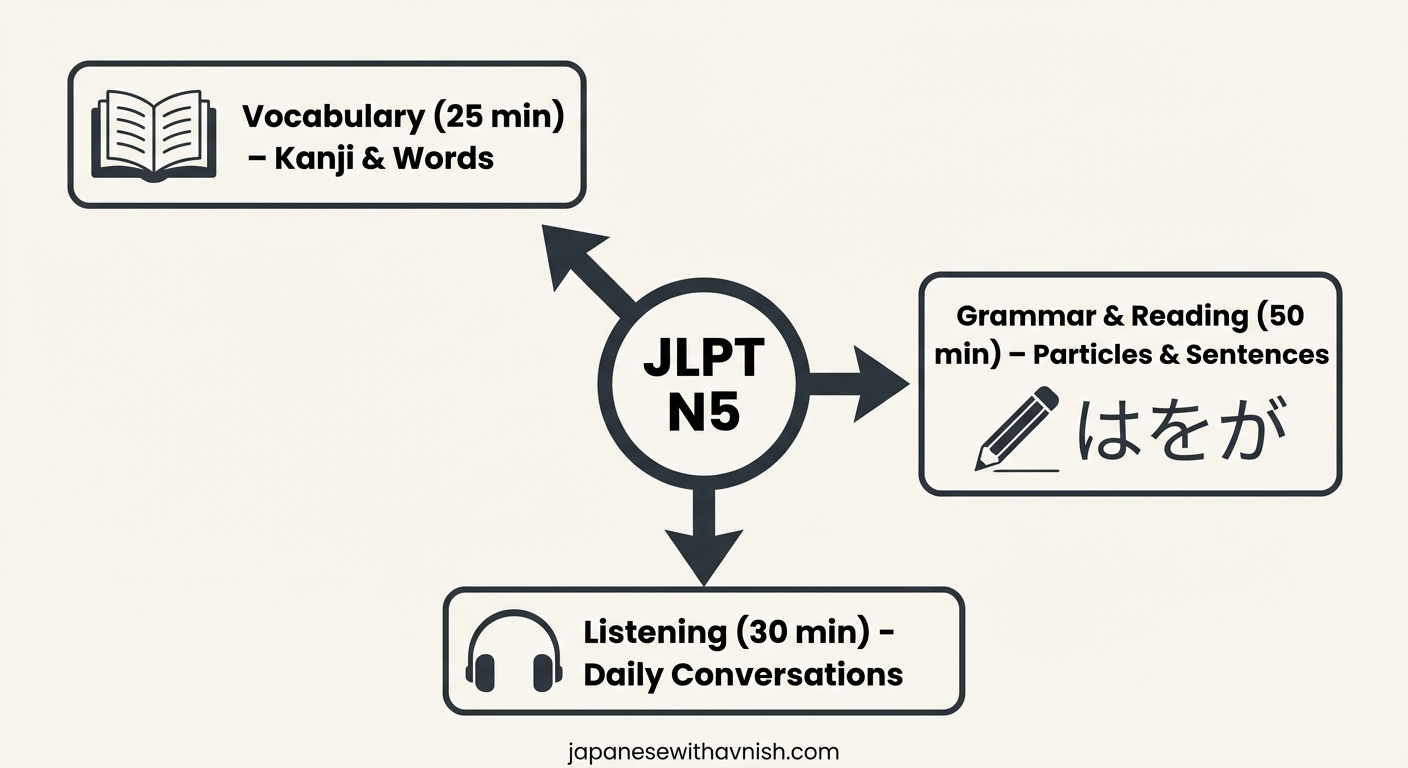 Before selecting books, it is essential to understand what the JLPT N5 exam assesses. The test is divided into three sections:
- Language Knowledge (Vocabulary): 25 minutes. Tests your knowledge of basic words and their usage in context, including some elementary kanji.
- Language Knowledge (Grammar) & Reading: 50 minutes. Evaluates your understanding of fundamental Japanese grammar and your ability to comprehend short, simple passages.
- Listening: 30 minutes. Assesses your ability to follow conversations and extracts about daily topics, spoken at a slow pace. The exam is entirely multiple-choice. Success requires not just knowledge, but familiarity with the test's format and timing. Your book choices should, therefore, address all these areas: script mastery, vocabulary, grammar, reading, and listening comprehension.
Core Philosophy: The Four Pillars of N5 Study
A balanced approach is key. Think of your N5 preparation as building upon four interconnected pillars:
- Script Mastery: Hiragana and Katakana are non-negotiable. You must be able to read and write them fluently before anything else.
- Grammar & Sentence Structure: Understanding how particles like は (wa), を (o), and が (ga) work, and how to form basic negative, past, and question sentences.
- Vocabulary Acquisition: Learning approximately 800 words used in everyday situations.
- Kanji Recognition: Recognising and understanding the meaning of about 100 fundamental kanji, such as 日 (sun/day), 人 (person), and 月 (moon/month). The best books for you will comprehensively support one or more of these pillars.
Category 1: Primary Textbooks & Integrated Courses
These books provide an all-in-one curriculum, introducing vocabulary, grammar, and cultural notes in a progressive manner. They are ideal for building your initial framework.
- Genki I: An Integrated Course in Elementary Japanese: Often considered the gold standard for university courses worldwide. Its strengths are clear grammar explanations in English, engaging dialogues, and plentiful practice exercises. It covers all N5 grammar and a significant portion of N4. The accompanying workbook is highly recommended for writing practice.
- Minna no Nihongo I (Main Textbook): This is a more immersive approach. The main textbook is entirely in Japanese, which can be daunting but is excellent for training your brain to think in the language from day one. It is absolutely essential to use it with its accompanying Translation & Grammatical Notes book. It is rigorous and highly effective.
- Japanese for Busy People I (Revised 4th Edition): A streamlined option for learners who want a more concise, goal-oriented approach. It focuses on practical communication and is less dense than Genki or Minna no Nihongo, making it a good choice for self-learners with limited time.
Study Tip: Whichever primary textbook you choose, commit to it. Complete the exercises, listen to the accompanying audio repeatedly, and practice writing the example sentences. Consistency with one core resource is more valuable than dipping into many.
Category 2: Dedicated Grammar Guides
While textbooks teach grammar in context, dedicated guides offer clear reference and consolidation. They are perfect for review and clarifying doubts.
- A Dictionary of Basic Japanese Grammar: This is not a traditional dictionary. It is an encyclopedic reference that explains grammar points in exceptional detail, with numerous example sentences. For example, it will deeply explain the nuances between particles に (ni) and で (de). It is an invaluable resource for the serious learner.
- Nihongo Sou Matome JLPT N5: Grammar, Reading, Listening: Part of a popular JLPT-focused series, this book breaks down N5 grammar into digestible, daily chunks over 6 weeks. Its format is very structured, providing focused practice and a clear study schedule. Example: 今日は暑いです。 (Kyou wa atsui desu.) - Today is hot.
Category 3: Kanji & Vocabulary Builders
Building a strong lexicon is critical. These resources specialise in helping you learn and retain words and characters.
- Basic Kanji Book, Vol. 1: A classic, step-by-step guide to the first 250 kanji. It teaches kanji in thematic groups, focusing on stroke order, meanings, and common compounds (words). For instance, it will teach 学校 (gakkou - school) after introducing 学 (learn) and 校 (school).
- Nihongo Challenge N4-5 Kanji: Despite the title, it's perfect for N5. It presents kanji with friendly illustrations, example vocabulary, and practice exercises that are directly aligned with the JLPT.
- N5 Vocabulary Flashcards (Any reputable brand): Physical or digital (like Anki decks tagged "JLPT N5"). The spaced repetition system (SRS) is scientifically proven for memorisation. Daily flashcard review for 15-20 minutes can dramatically accelerate your vocabulary acquisition. Example words: たべます (tabemasu - to eat), いきます (ikimasu - to go), しごと (shigoto - job).
Category 4: Practice & Mock Tests
Applying your knowledge under test-like conditions is the final, crucial step. These books train your exam technique.
- JLPT Official Practice Workbook (N5): Published by the Japan Foundation, this is the most authentic practice material available. It contains one full-length practice test with an answer key and a CD for the listening section. This should be your benchmark.
- Shin Kanzen Master JLPT N5: Reading & Listening: Although the Kanzen Master series is known for higher levels, their N5 reading and listening books offer excellent, slightly challenging practice to ensure you are over-prepared.
- Nihongo So-Matome JLPT N5: Practice Questions: A good supplement for additional drilling across all sections of the exam.
Study Tip: Save the official practice workbook for the final 2-3 weeks before your exam. Use it as a timed mock test to identify your weak areas.
Creating Your Personalised N5 Study Plan
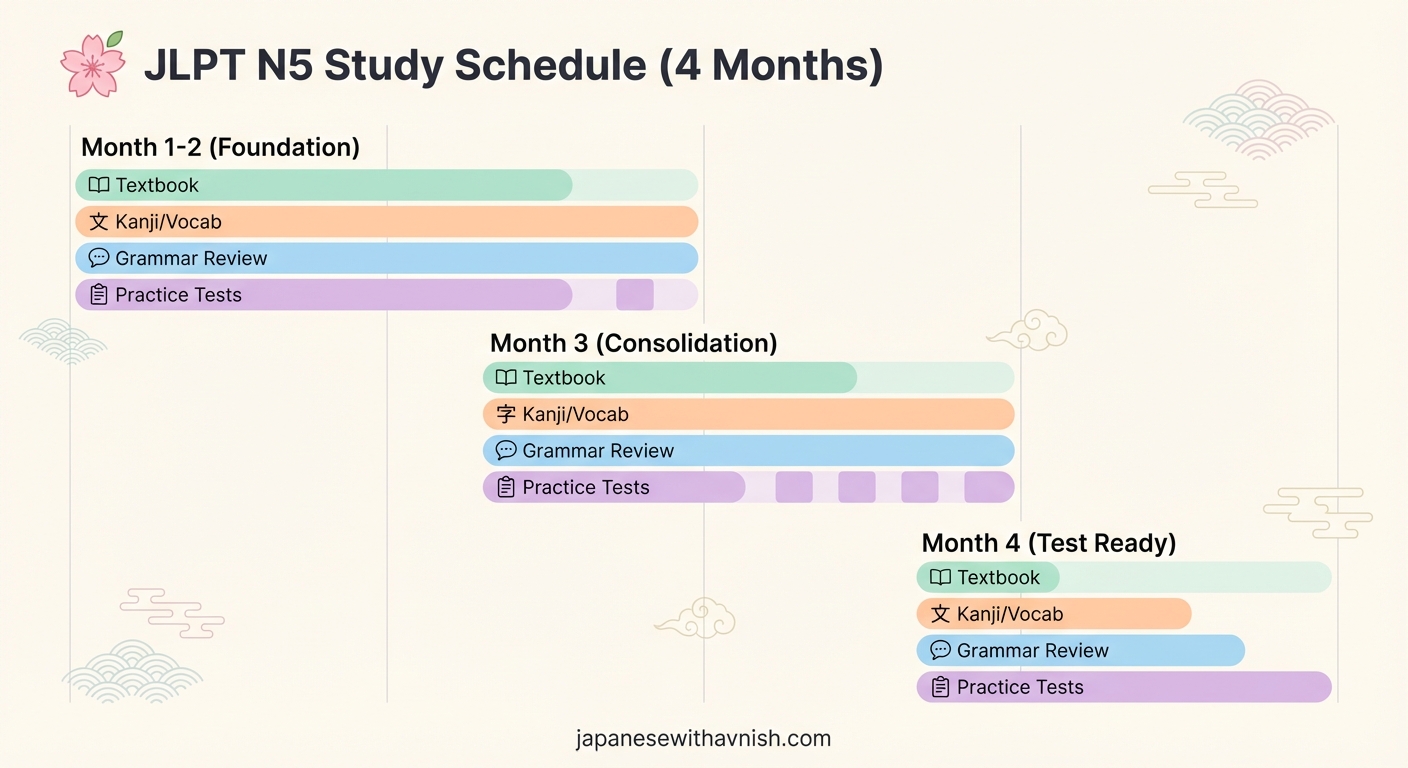 A collection of books is only as good as the plan to use them. Here is a suggested 4-month study schedule framework:
- Month 1-2: Foundation Building. Focus entirely on your Primary Textbook (e.g., Genki I Chapters 1-6). Master hiragana and katakana in the first week. Simultaneously, begin daily Kanji & Vocabulary study (5 kanji/15 words per day).
- Month 3: Consolidation & Grammar Deep Dive. Continue with your textbook. Use your Dedicated Grammar Guide to review and solidify concepts. Start incorporating exercises from your Practice books for grammar and reading.
- Month 4: Application & Test Readiness. Complete your primary textbook. Intensify practice with full sections from practice books. In the final weeks, take the Official Practice Workbook test under timed conditions. Focus intensely on listening practice daily.
For learners seeking a pre-structured, comprehensive system that integrates all these elements—grammar, vocabulary, kanji, and practice—our Japanese N5 Mastery Bundle provides a curated, step-by-step pathway designed to eliminate guesswork and ensure all foundational pillars are firmly established.
Conclusion: Your Next Steps on the Path
Choosing the right books for JLPT N5 is about selecting tools that align with your learning style and building a balanced routine around them. Start with a strong primary textbook, support it with specialised guides for grammar and kanji, and validate your progress with targeted practice tests. Remember, consistency and quality practice trump sheer volume of resources. Your journey in Japanese begins with this solid N5 foundation. Approach your studies with calm focus, trust in your selected materials, and engage with the language daily. If you prefer a structured, ready-made study system that harmonises all these recommended resource types into a single, coherent plan, you may explore our Japanese N5 Mastery Bundle, designed to provide serious learners with clarity and comprehensive coverage from the very first step.
Summary
Embarking on the JLPT N5 journey requires building a solid foundation in Japanese, and selecting the right study materials is crucial. This guide provides a structured approach to choosing the most effective resources, organized around four essential pillars: script mastery (hiragana and katakana), grammar and sentence structure, vocabulary acquisition (about 800 words), and kanji recognition (roughly 100 characters). Understanding the exam’s three sections—Vocabulary, Grammar & Reading, and Listening—informs which books will best prepare you. Primary textbooks like *Genki I*, *Minna no Nihongo I*, and *Japanese for Busy People I* offer integrated courses, progressively introducing grammar, vocabulary, and culture. Dedicated grammar guides, such as *A Dictionary of Basic Japanese Grammar* or the *Nihongo Sou Matome* series, provide detailed references and consolidation. For kanji and vocabulary, resources like *Basic Kanji Book, Vol. 1* and spaced-repetition flashcards are recommended for systematic learning. Finally, practice materials like the official *JLPT Practice Workbook* and supplementary drills are vital for applying knowledge under test conditions. A suggested four-month study plan outlines how to integrate these resources: focus on a primary textbook and daily kanji/vocabulary for the first two months, deepen grammar understanding in the third month, and intensify practice and mock tests in the final month. Consistency with your core materials is emphasized over accumulating numerous resources. By following this balanced approach, learners can transform a daunting task into a clear, manageable path to mastering the fundamentals of Japanese.
What should you do next?
Recommended next reads
JLPT N5 Roadmap: Your Structured Guide to Success
A comprehensive, step-by-step guide to passing the JLPT N5. Covers exam structure, study plan, essential grammar, vocabulary, and kanji for beginners.
30 Day Plan for JLPT N5: A Day-by-Day Study Guide
A structured 30-day, day-by-day study plan for JLPT N5 success. Covers vocabulary, grammar, reading, listening with a clear schedule for beginners.
Comments
Add a comment
Recommended bundles for you
Structured study materials to accelerate your JLPT journey.