JLPT N5 Roadmap: Your Structured Guide to Success
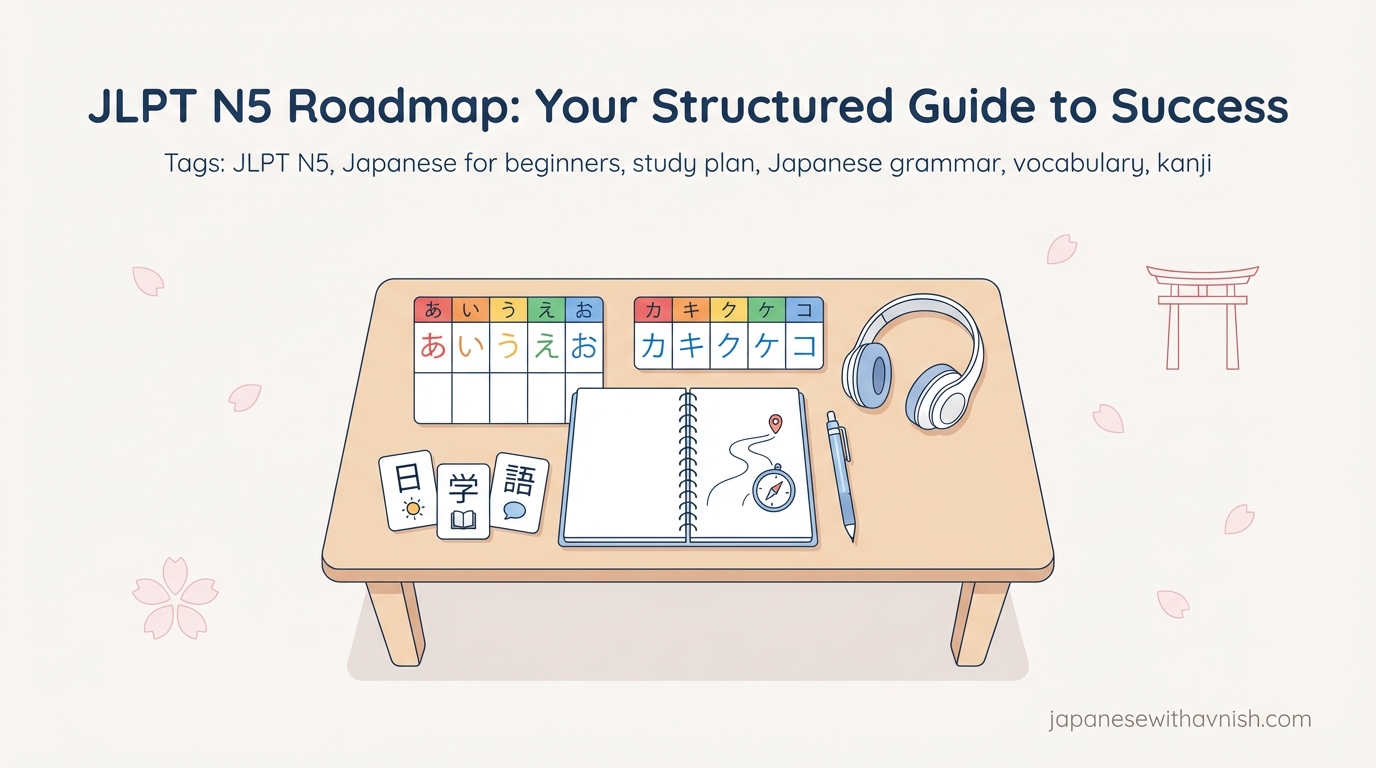
JLPT N5 Roadmap: Your Structured Guide to Success
Embarking on the journey to learn Japanese is a commendable and culturally enriching endeavor. The Japanese Language Proficiency Test (JLPT) N5 level serves as the foundational gateway, validating your initial steps into this intricate and beautiful language. For many learners, especially self-learners, the path can seem unstructured and overwhelming. This guide provides a calm, structured, and comprehensive roadmap to demystify the JLPT N5, breaking down the process into manageable, actionable steps. With a clear plan and consistent effort, success at the N5 level is not just a possibility but an achievable milestone.
Table of Contents
- Understanding the JLPT N5 Exam Structure
- Foundational Pillar 1: Mastering Hiragana and Katakana
- Foundational Pillar 2: Essential N5 Vocabulary
- Foundational Pillar 3: Core N5 Grammar Patterns
- Foundational Pillar 4: Introduction to N5 Kanji
- Creating Your Personal 12-Week Study Plan
- Practical Application and Listening Practice
- Recommended Resources and Final Preparation
Understanding the JLPT N5 Exam Structure
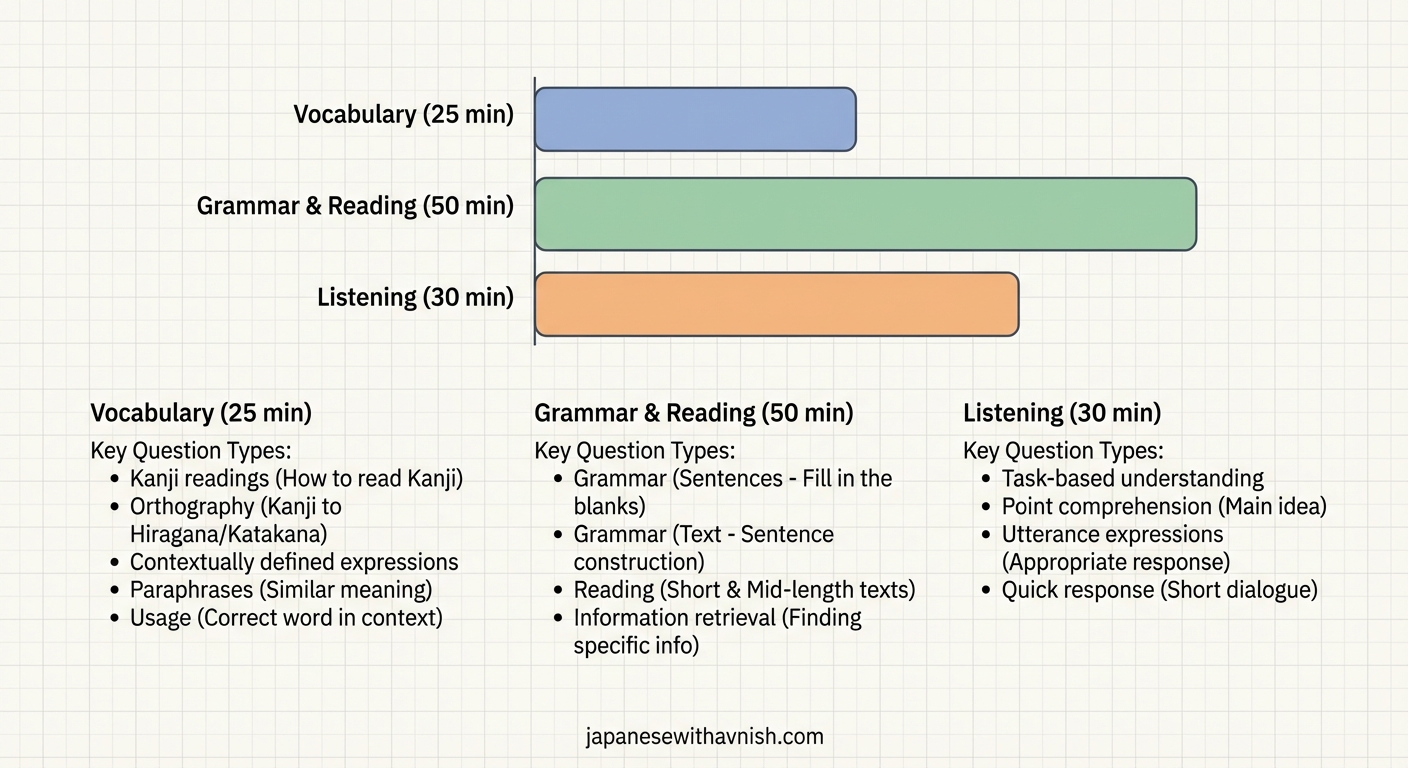 A clear understanding of the test format is the first step in any successful preparation. The JLPT N5 exam is divided into three main sections, designed to assess your basic language skills. The total test duration is 105 minutes.
- Language Knowledge (Vocabulary) – 25 minutes: This section tests your understanding of basic Japanese words in hiragana, katakana, and very basic kanji. Question types include word reading, orthography (correct character usage), and contextually appropriate word choice.
- Language Knowledge (Grammar) & Reading – 50 minutes: This combined section evaluates your grasp of fundamental grammar and your ability to comprehend short, simple passages. You will encounter questions on sentence structure, particle usage, and reading short notices, messages, or paragraphs of about 80-100 characters.
- Listening – 30 minutes: This section assesses your ability to understand everyday conversations and announcements spoken at a slow pace. Tasks include identifying key information in short dialogues, understanding the main point of a conversation, and responding appropriately to verbal cues.
Knowing this structure allows you to tailor your study efforts effectively, ensuring you allocate time to each skill area.
Foundational Pillar 1: Mastering Hiragana and Katakana
Before diving into vocabulary or grammar, absolute mastery of the two phonetic scripts, hiragana and katakana, is non-negotiable. Hiragana (e.g., あ、い、う、え、お) is used for native Japanese words and grammatical elements. Katakana (e.g., カ、キ、ク、ケ、コ) is primarily used for foreign loanwords, onomatopoeia, and technical terms.
Study Tip: Dedicate 1-2 weeks solely to this. Use flashcards, writing practice sheets, and mnemonics. Aim for instant recognition and accurate writing. Practice reading simple words like さくら (sakura – cherry blossom) in hiragana and テーブル (tēburu – table) in katakana. This foundation will make every subsequent step exponentially easier.
Foundational Pillar 2: Essential N5 Vocabulary
The official JLPT guidelines suggest knowledge of approximately 800 vocabulary words for N5. These words cover daily life topics: personal information, family, shopping, food, weather, and common activities.
Effective Strategy:
- Categorize: Learn words in thematic groups (e.g., food: りんご (ringo – apple), ごはん (gohan – meal/rice), みず (mizu – water)).
- Use in Context: Never learn words in isolation. Always associate them with a simple sentence or image.
- Daily Review: Consistent, spaced repetition is key. Use digital flashcard apps or physical cards.
Example vocabulary: 行く (iku – to go), 大きい (ōkii – big), 学生 (gakusei – student).
Foundational Pillar 3: Core N5 Grammar Patterns
N5 grammar introduces the fundamental building blocks of Japanese sentences. Focus on understanding the function and usage of each pattern rather than just memorizing translations.
Key Grammar Points to Master:
- Sentence structure: [Topic] は [Subject] が [Adjective/Verb].
- Particles: は (topic marker), が (subject marker), を (object marker), に (time/location marker), で (location of action).
- Verb conjugations: Present affirmative (~ます form), present negative (~ません), past affirmative (~ました), past negative (~ませんでした).
- Adjectives: い-adjectives (e.g., あつい – hot) and な-adjectives (e.g., しずか – quiet) and their conjugations.
- Question words: 何 (なに/なん – what), どこ (where), だれ (who), いつ (when).
Example Sentences:
- 私は学生です。 (Watashi wa gakusei desu.) – I am a student.
- 昨日、公園で本を読みました。 (Kinō, kōen de hon o yomimashita.) – Yesterday, I read a book in the park.
- このりんごは大きいです。 (Kono ringo wa ōkii desu.) – This apple is big.
Foundational Pillar 4: Introduction to N5 Kanji
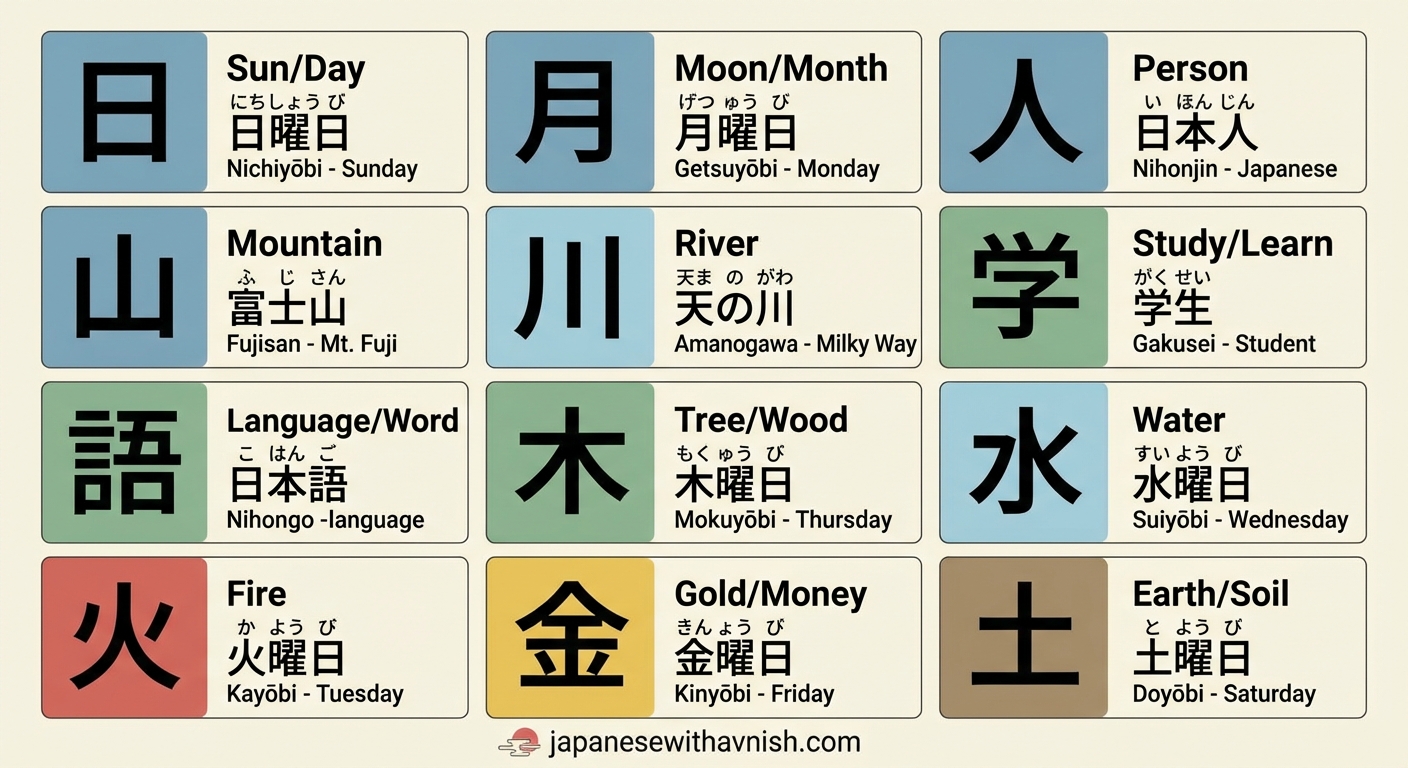 The N5 level introduces around 100 kanji characters. The goal is recognition and understanding of their basic meanings and common readings (onyomi – Chinese-derived reading, and kunyomi – Japanese-derived reading).
Approach: Start with simple, high-frequency kanji that are often used in daily life and form the basis of other characters.
Essential Starter Kanji:
- 日 (ひ / ニチ): sun, day
- 月 (つき / ゲツ): moon, month
- 人 (ひと / ジン): person
- 山 (やま / サン): mountain
- 川 (かわ / セン): river
- 学 (ガク): study (as in 学生 – gakusei – student)
- 語 (ゴ): language (as in 日本語 – nihongo – Japanese language)
Practice by writing them repeatedly and learning them within vocabulary words, such as 日曜日 (nichiyōbi – Sunday) or 日本人 (nihonjin – Japanese person).
Creating Your Personal 12-Week Study Plan
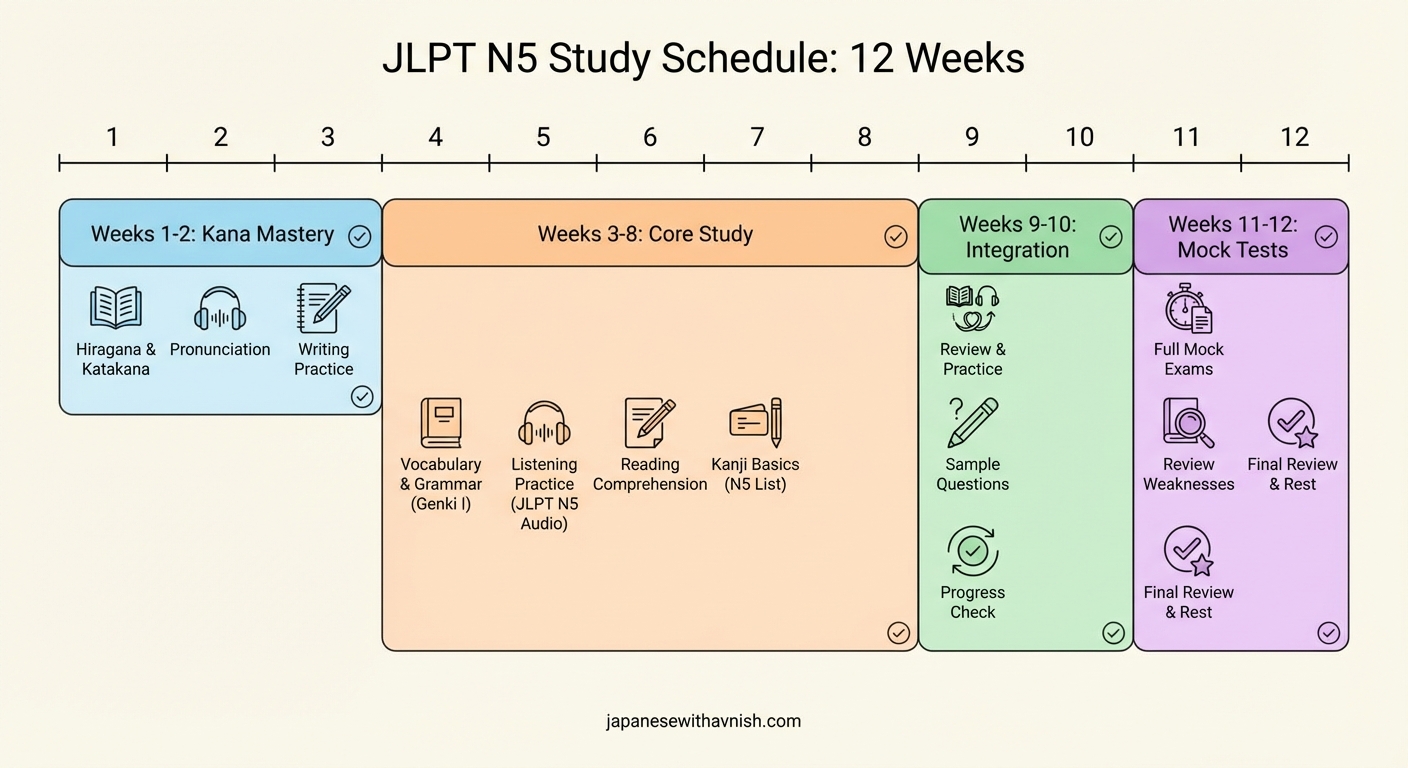 Consistency is more valuable than intensity. A 12-week (approximately 3-month) plan is ideal for balanced preparation, assuming 1-1.5 hours of study per day.
Sample 12-Week Study Roadmap:
- Weeks 1-2: Intensive focus on Hiragana and Katakana mastery.
- Weeks 3-8: Core Study Phase. Alternate days between Vocabulary (15-20 new words/day) and Grammar (2-3 new patterns/day). Integrate the week's kanji (8-10/week).
- Weeks 9-10: Integration & Reading. Start reading very short passages, children's stories, or textbook dialogues. Practice forming your own simple sentences using learned material.
- Weeks 11-12: Mock Tests & Review. Take full-length practice tests under timed conditions. Identify weak areas and review all vocabulary, grammar, and kanji lists thoroughly.
This structured approach prevents cramming and ensures all language components develop together. For a pre-made, systematic study system that follows this philosophy, consider exploring our N5 Mastery Bundle, which organizes grammar, vocabulary, and practice into a coherent daily plan.
Practical Application and Listening Practice
Language is for communication. Actively using what you learn solidifies knowledge.
- Listening: Daily exposure is crucial. Use resources with scripts for N5 learners. Listen to the same audio multiple times: first for gist, then while reading the script, then again for detail. Practice with the question formats from the exam.
- Speaking/Shadowing: Repeat phrases and sentences after audio recordings to improve pronunciation and rhythm.
- Writing: Keep a simple journal. Write 2-3 sentences daily about your day using N5 vocabulary and grammar (e.g., 今日は暑かったです。学校に行きました。 – Today was hot. I went to school.).
Recommended Resources and Final Preparation
Choose one primary textbook as your spine, such as "Genki I" or "Minna no Nihongo," which are structured around JLPT N5 content. Supplement with:
- Official JLPT Practice Workbooks.
- Flashcard apps like Anki or Quizlet for vocabulary and kanji.
- Online platforms for listening practice.
In the Final Weeks:
- Complete at least 2-3 full mock exams.
- Create error logs to track and review mistakes.
- Focus on time management during the test.
- Ensure you understand the test day procedures.
Embarking on the JLPT N5 journey with a structured roadmap transforms an intimidating challenge into a series of clear, achievable tasks. By systematically building your skills in kana, vocabulary, grammar, and kanji, and applying them through consistent practice, you lay a robust foundation not just for the exam, but for all future Japanese learning. Remember, the goal is not merely to pass a test, but to build genuine communicative ability.
If you prefer a structured, ready-made study system that integrates all these elements—grammar explanations, curated vocabulary lists, kanji drills, audio practice, and mock tests—into a single, coherent learning path, explore our Japanese N5 Mastery Bundle. It is designed to provide the clarity and structure that serious learners need to progress with confidence and efficiency.
Summary
This guide provides a structured roadmap for learners preparing for the JLPT N5, the foundational level of the Japanese Language Proficiency Test. It begins by demystifying the 105-minute exam, which is divided into three sections: Vocabulary (25 minutes), Grammar & Reading (50 minutes), and Listening (30 minutes). Understanding this format is the first step to tailoring an effective study plan. The core of the preparation rests on four foundational pillars. First, learners must achieve absolute mastery of the hiragana and katakana scripts, dedicating 1-2 weeks to this essential step. Next, building a vocabulary of approximately 800 words through thematic study and daily review is crucial. The third pillar involves mastering core grammar patterns, including basic sentence structure, key particles, verb conjugations, and question words. Finally, the introduction to around 100 essential kanji focuses on recognition and learning characters within common vocabulary. To integrate these elements, the guide recommends a manageable 12-week study plan. This roadmap suggests an initial intensive focus on kana, followed by a core phase alternating vocabulary and grammar study while integrating kanji. The final weeks should emphasize reading integration, practical application through writing and listening, and taking timed mock tests. Consistency with 1-1.5 hours of daily study is emphasized over cramming. The conclusion stresses that language is for communication, encouraging daily listening practice, speaking shadowing, and simple writing exercises. It recommends using a primary textbook like "Genki I" supplemented with official practice workbooks and flashcard apps. The ultimate goal is not merely to pass the test but to build a genuine communicative foundation for all future Japanese learning, a process made achievable by following this clear, structured approach.
What should you do next?
Recommended next reads
Best Books for JLPT N5: A Structured Guide for Your Foundation
A structured guide to the best textbooks, kanji, grammar, and practice books for JLPT N5. Build a solid foundation with our expert recommendations and study plan.
30 Day Plan for JLPT N5: A Day-by-Day Study Guide
A structured 30-day, day-by-day study plan for JLPT N5 success. Covers vocabulary, grammar, reading, listening with a clear schedule for beginners.
Comments
Add a comment
Recommended bundles for you
Structured study materials to accelerate your JLPT journey.