JLPT N4 Roadmap: Your Structured Guide to Success
JLPT N4 Roadmap: Your Structured Guide to Success
Congratulations on reaching the JLPT N4 milestone. This level represents a significant bridge from the foundational N5 to a more practical, conversational command of Japanese. The journey from understanding basic sentences to engaging with everyday topics can feel daunting without a clear path. This guide provides a calm, structured roadmap, breaking down the N4 syllabus into manageable components and offering a proven study plan. Success is not about innate talent, but about consistent, focused effort guided by the right strategy.
Table of Contents
- Understanding the JLPT N4 Exam Structure
- The Core Components: Grammar, Vocabulary, and Kanji
- Building Your N4 Study Schedule
- Mastering N4 Grammar Patterns
- Expanding Your N4 Vocabulary and Kanji
- Sharpening Your Listening and Reading Skills
- Final Preparation and Test-Day Strategy
- Your Next Steps: From N4 to N3
Understanding the JLPT N4 Exam Structure
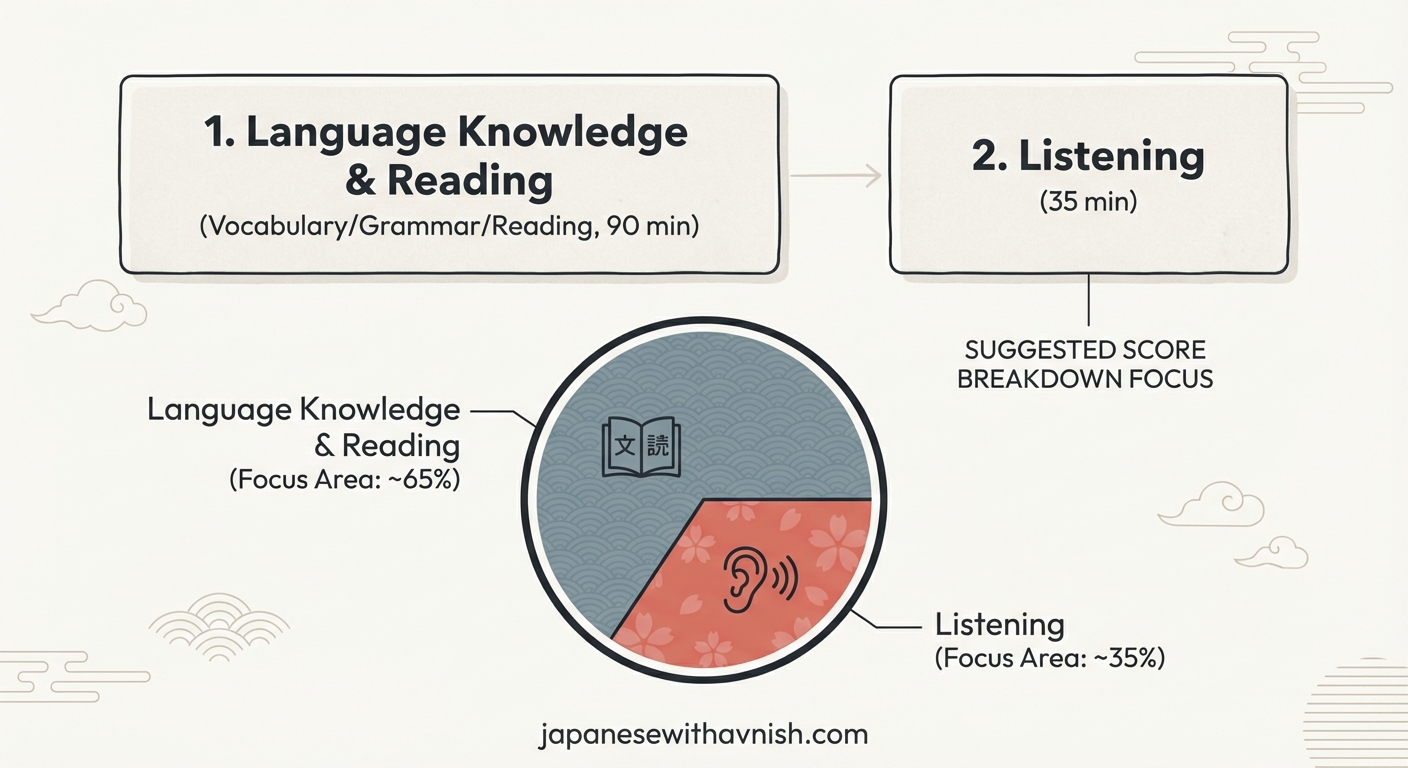 The JLPT N4 exam is designed to assess your ability to understand basic Japanese used in everyday situations. It consists of three sections, administered in a specific order with strict time limits. A clear understanding of this structure is the first step in strategic preparation.
Language Knowledge (Vocabulary & Grammar) & Reading (30 minutes + 60 minutes): This combined section is 90 minutes long. The first part tests vocabulary through word reading, orthography (correct character usage), and contextually-defined expressions. The second part covers grammar with sentence formation and text grammar questions. The reading comprehension section follows, requiring you to understand short passages on daily topics.
Listening (35 minutes): This section evaluates your ability to comprehend spoken Japanese in everyday contexts. It includes task-based comprehension (understanding the appropriate response), point comprehension (catching key details), and utterance expressions (choosing the correct phrase for a situation).
The Core Components: Grammar, Vocabulary, and Kanji
To pass N4, you must build proficiency in three interconnected areas. Think of grammar as the skeleton, vocabulary as the muscles, and kanji as the distinctive features that give the language its form.
Grammar (ぶんぽう): You are expected to know approximately 150-170 grammar points. These include more complex sentence connectors, different levels of politeness (like ~てください vs. ~ていただけませんか), and expressions for giving/receiving (あげる、くれる、もらう).
Vocabulary (ごい): You need to know around 1,500 words (building on the 800 from N5). Focus on verbs, adjectives, and adverbs used in daily life, such as 運転する (to drive), 複雑な (complicated), and ぜひ (by all means).
Kanji (かんじ): The N4 requires knowledge of about 300 kanji (adding ~200 to the N5's 100). You must be able to read them in context. While writing is not tested, practicing writing aids memorization. Examples include 駅 (eki - station), 料金 (ryoukin - fee), and 不便な (fuben na - inconvenient).
Building Your N4 Study Schedule
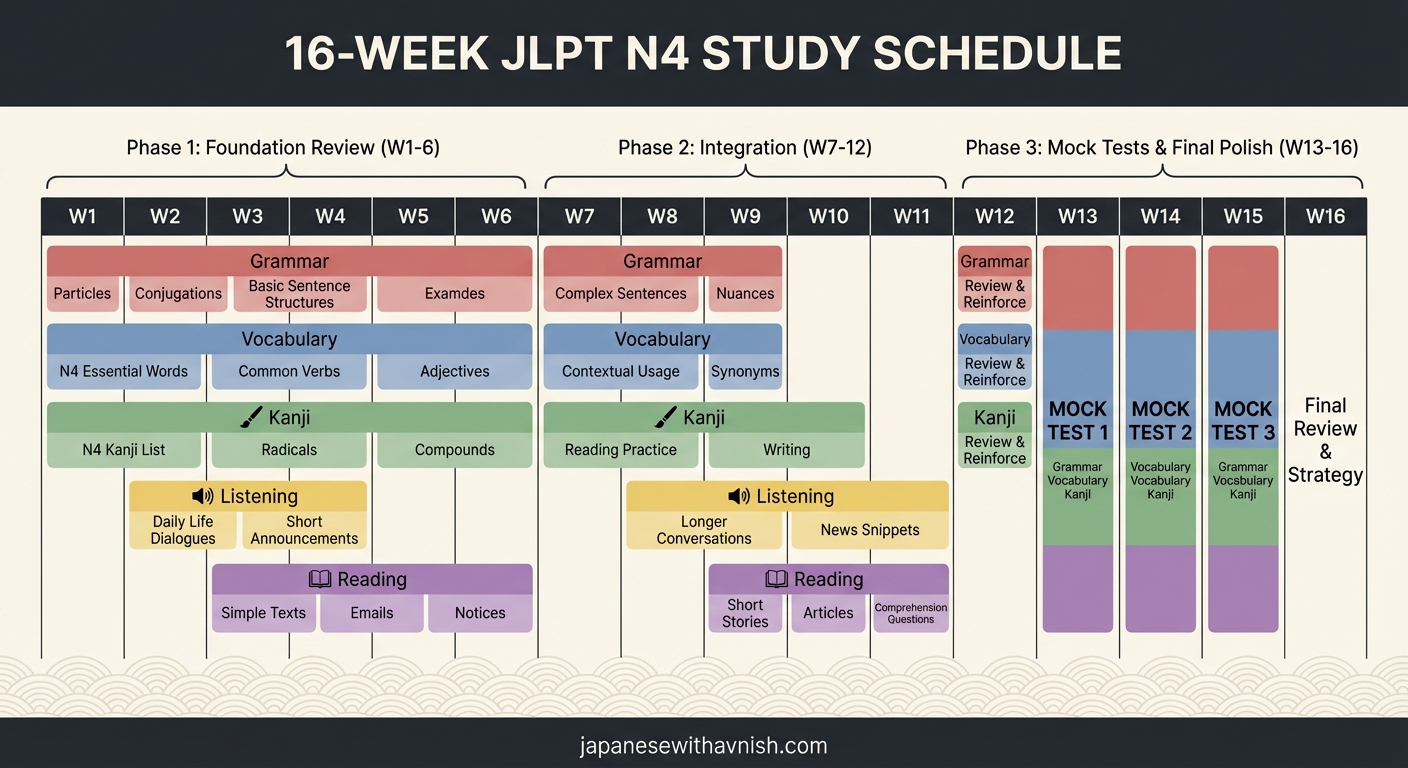 A structured schedule transforms an overwhelming goal into daily achievable tasks. A recommended 3–4 month plan for dedicated learners is outlined below. Adjust the intensity based on your available time.
Phase 1: Foundation Review & New Grammar (Weeks 1-6)
- Daily (1 hour): Review N5 kanji (15 mins). Learn 5 new N4 kanji and 15 new vocabulary words. Study 3-4 new grammar points.
- Weekly (2 hours): Complete practice exercises for the week's grammar. Write short paragraphs using new vocabulary and grammar.
Phase 2: Integration & Listening Focus (Weeks 7-12)
- Daily (1.5 hours): Continue kanji/vocab review. Practice reading short articles or dialogues. Dedicate 20-30 minutes to active listening practice.
- Weekly (2.5 hours): Take a full practice reading section. Do shadowing exercises with listening scripts.
Phase 3: Mock Tests & Refinement (Weeks 13-16)
- Focus: Shift entirely to mock exams and targeted review. Identify weak areas from test results and revisit them.
- Weekly: Complete one full-length timed mock test. Analyze every mistake.
Consistency is paramount. Using a dedicated resource system can streamline this process. Our Japanese N4 Upgrade Bundle provides the structured curriculum, targeted exercises, and audio drills to execute this plan efficiently.
Mastering N4 Grammar Patterns
N4 grammar introduces concepts that allow for more nuanced expression. Let's examine a few key patterns.
-
~てみる (Try doing...): Used to express trying something out.
- 日本の料理を食べてみたいです。 (I want to try eating Japanese food.)
-
~し、~し (And also; for multiple reasons): Lists reasons or facts.
- このアパートは静かだし、駅に近いし、とてもいいです。 (This apartment is quiet, close to the station, and very good.)
-
~なければならない (Must/have to): Expresses obligation.
- 明日は早く起きなければならない。 (I have to get up early tomorrow.)
-
~たことがある (Have had the experience of...): Talks about past experiences.
- 富士山を見たことがありますか。 (Have you ever seen Mt. Fuji?)
Practice these by creating your own sentences relevant to your life, moving beyond textbook examples.
Expanding Your N4 Vocabulary and Kanji
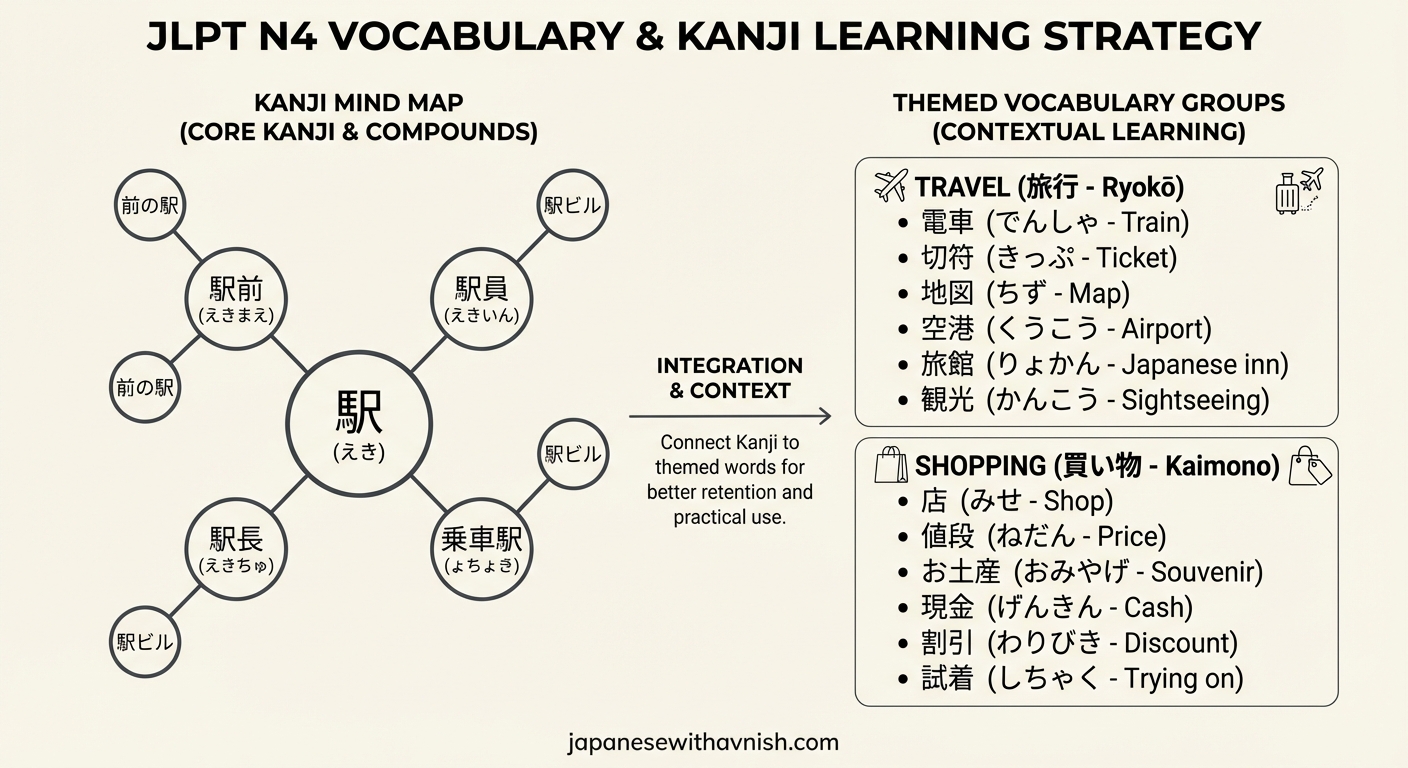 Effective learning involves active engagement with words and characters.
Vocabulary Strategy: Group words by theme (e.g., travel, shopping, health). Use them immediately. Instead of just memorizing "予定 (yotei - plan)," write: "週末の予定は何ですか。" (What are your plans for the weekend?).
Kanji Strategy: Learn kanji in compounds (熟語 - jukugo). For 駅 (station), learn 駅前 (ekimae - in front of the station) and 駅員 (ekiin - station staff). Use flashcards, but always reinforce with reading. Seeing "地下鉄の駅" (chikatetsu no eki - subway station) in a sentence solidifies meaning better than an isolated card.
Sharpening Your Listening and Reading Skills
Listening Practice: Move beyond passive listening. Use practice test audio for "active listening." First, listen for gist. Second, listen while reading the script, noting unfamiliar pronunciations. Third, try "shadowing"—speaking along with the audio to improve rhythm and intonation. Focus on question words (どうして、いつ、だれが) and negative forms, which are often key to correct answers.
Reading Practice: Start with short, simple dialogues and announcements. Practice skimming for the main idea before looking at questions. Then scan for specific information. Time your practice to build speed. Encountering grammar and vocabulary in context is the most powerful form of review.
Final Preparation and Test-Day Strategy
In the final two weeks, your focus should shift from learning new material to optimization and simulation.
Review Weak Areas: Use your error log from mock tests. Re-study grammar points or kanji you consistently miss.
Take Full-Length Mock Tests: Simulate real exam conditions—strict timing, no interruptions, using an answer sheet. This builds stamina and time-management skills.
Test-Day Strategy:
- Language Knowledge/Reading: Answer vocabulary questions quickly to save time for reading comprehension. For reading, read the questions first, then the passage.
- Listening: Mark your answer immediately during the pause. If unsure, guess and move on; you cannot revisit questions. Stay focused; the audio plays only once.
Your Next Steps: From N4 to N3
Passing the JLPT N4 is a commendable achievement that proves your ability to handle everyday Japanese. It forms the essential foundation for the intermediate N3 level, where you will encounter more abstract topics, longer texts, and faster, more natural spoken dialogue.
The transition requires a deepening of all skills, particularly in building a more extensive vocabulary (~2,000 new words) and kanji knowledge (~350 new characters). Continuing with a structured approach is crucial. For learners aiming for a seamless progression, our Complete Japanese N5-N1 Mega Bundle offers a continuous, comprehensive learning path from beginner to advanced levels.
Remember, language acquisition is a journey of persistent steps. This N4 roadmap provides the structure; your consistent practice provides the motion. Approach your studies with calm focus, and you will build the competence needed for success.
If you prefer a structured, ready-made study system that integrates grammar, vocabulary, kanji, and practice tests into a coherent plan, explore our Japanese N4 Upgrade Bundle. It is designed to provide the clarity and resources serious learners need to navigate the N4 journey with confidence.
Summary
This guide provides a structured roadmap for mastering the JLPT N4, positioning it as the crucial bridge from basic understanding to practical, everyday Japanese. Success is framed as a product of consistent effort and a clear strategy, not innate talent. The exam consists of two timed sections: a 90-minute combined test of Language Knowledge (vocabulary and grammar) and Reading, followed by a 35-minute Listening section. To pass, you must build proficiency in three core areas: approximately 150-170 grammar points (like ~てみる for trying something or ~なければならない for obligation), a vocabulary of about 1,500 words, and the ability to read roughly 300 kanji in context. A recommended 3–4 month study plan breaks the journey into manageable phases. The first six weeks focus on building a foundation through daily review and learning new grammar. Weeks 7-12 integrate these skills with dedicated reading and active listening practice. The final month is for refinement through full-length mock tests and targeted review of weak areas. For effective skill development, the guide advises learning vocabulary in thematic groups and kanji within common compounds. Listening skills are honed through active techniques like shadowing, while reading practice emphasizes skimming and scanning under timed conditions. As test day approaches, the focus shifts to simulating exam conditions and optimizing performance through strategic question-answering techniques. Ultimately, passing the N4 validates your ability to handle daily situations and forms the essential foundation for the intermediate N3 level. The journey requires persistent, focused practice, and this roadmap provides the structure to navigate it with confidence.
What should you do next?
Recommended next reads
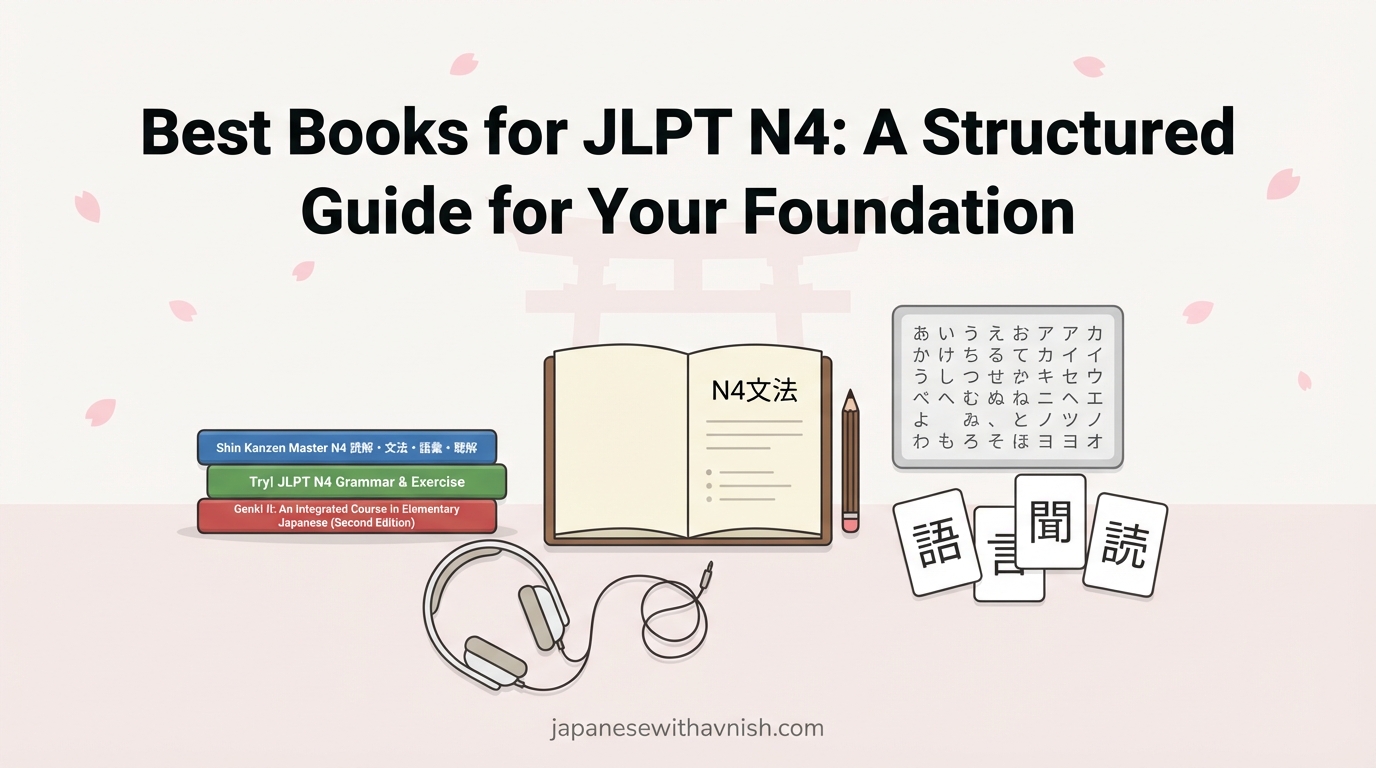
Best Books for JLPT N4: A Structured Guide for Your Foundation
A calm, structured guide to the best textbooks, drill books, and practice tests for JLPT N4. Build a solid foundation with our expert resource recommendations and study plan.
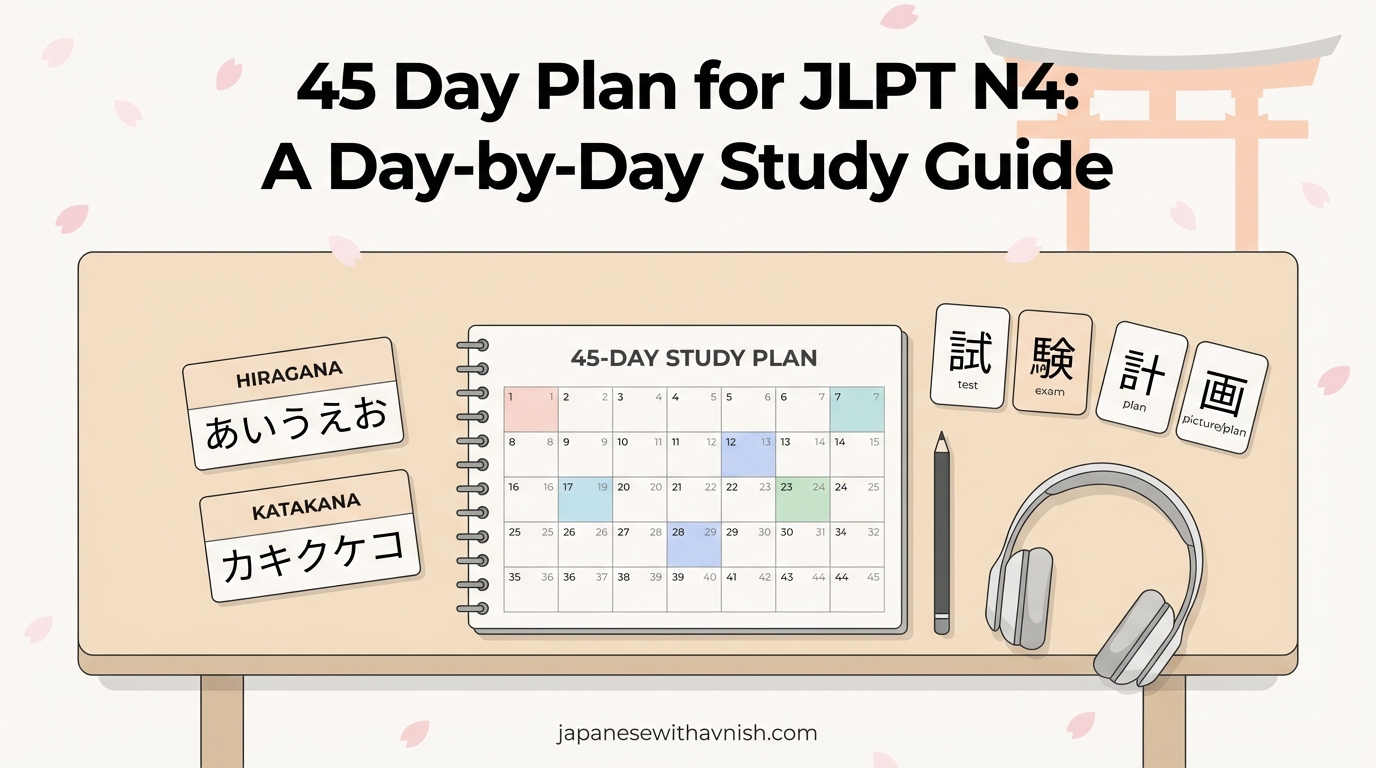
45 Day Plan for JLPT N4: A Day-by-Day Study Guide
A complete 45-day structured study guide for JLPT N4 success. Covers grammar, vocabulary, kanji, listening, and includes a daily schedule, resources, and final week strategy.
Comments
Add a comment
Recommended bundles for you
Structured study materials to accelerate your JLPT journey.