30 Day Plan for JLPT N5: A Day-by-Day Study Guide
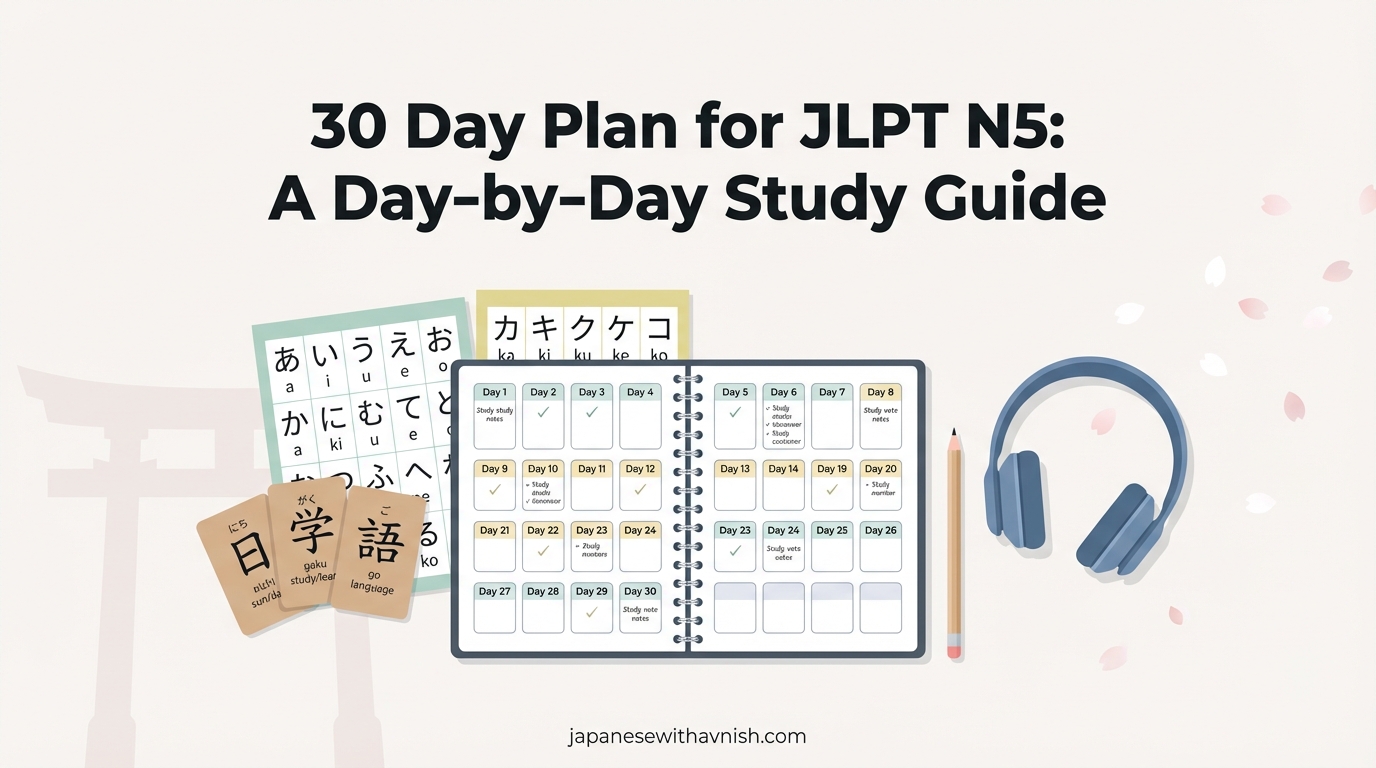
30 Day Plan for JLPT N5 - Day Wise
Embarking on the journey to pass the Japanese-Language Proficiency Test (JLPT) N5 is a commendable first step towards mastering the language. For many learners, especially those balancing studies with other commitments, the prospect can seem daunting. However, with a clear, structured, and disciplined approach, success is not only possible but highly achievable. This 30-day plan is designed to transform your preparation from a vague ambition into a manageable, day-by-day roadmap. It breaks down the essential components of the N5 exam—Vocabulary, Grammar, Reading, and Listening—into focused daily tasks, ensuring comprehensive coverage without overwhelm. By following this guide, you will build a solid foundation, reinforce your knowledge through consistent practice, and approach your exam day with confidence and calm preparedness.
Table of Contents
- Understanding the JLPT N5 Exam Structure
- The Philosophy Behind the 30-Day Intensive Plan
- Your 30-Day JLPT N5 Study Plan: Day-by-Day Breakdown
- Week 1-4 Focus & Strategy Overview
- Essential Study Tips for Maximum Retention
- Recommended Resources for Your Journey
- Final Week Strategy and Exam Day Mindset
Understanding the JLPT N5 Exam Structure
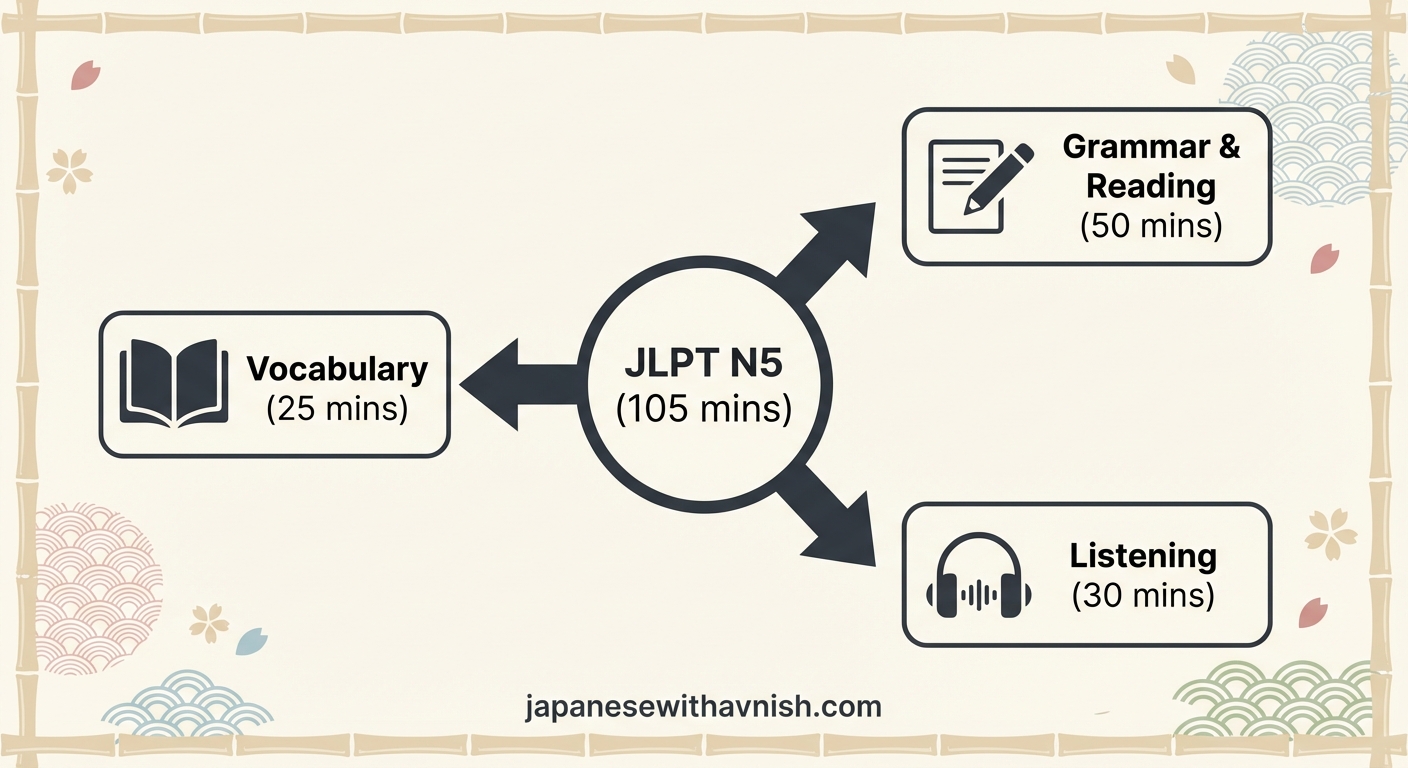 A clear understanding of your target is the first step to conquering it. The JLPT N5 assesses the most basic level of Japanese proficiency. The exam is divided into three sections, with a total test time of 105 minutes.
-
Language Knowledge (Vocabulary) – 25 minutes: This section tests your grasp of basic words and their usage in context. You need to know approximately 800 vocabulary words, primarily written in hiragana and katakana, with about 100 fundamental kanji.
- Example Question Type: Choosing the correct hiragana reading for a kanji word. (e.g., 学生 is read as がくせい).
-
Language Knowledge (Grammar) & Reading – 50 minutes: This combined section evaluates your understanding of basic Japanese sentence structure and your ability to comprehend short, simple passages.
- Grammar covers particles (は、が、を、に、で、へ、と、や、など), verb conjugations (present/future, past, negative forms), and simple sentence patterns.
- Reading involves short notices, messages, and paragraphs of 80-100 characters.
- Example Sentence: 私は毎日コーヒーを飲みます。 (I drink coffee every day.)
-
Listening – 30 minutes: This section tests your ability to understand spoken Japanese in everyday situations. Dialogues are short and clear, focusing on topics like daily life, shopping, and simple directions.
- Example Task: Listening to a question like "何時ですか。" (What time is it?) and choosing the correct picture of a clock.
Knowing this structure allows you to allocate your study time effectively, ensuring no section is neglected.
The Philosophy Behind the 30-Day Intensive Plan
This plan is built on three core principles: Consistency, Balance, and Active Recall. Cramming is ineffective for language acquisition. Instead, we focus on daily, manageable study sessions that cover all exam areas. Each day balances learning new material with reviewing old concepts, preventing knowledge decay. The plan emphasizes active practice—writing, speaking, and doing exercises—over passive reading, which dramatically improves retention and builds the speed needed for the timed exam.
Your 30-Day JLPT N5 Study Plan: Day-by-Day Breakdown
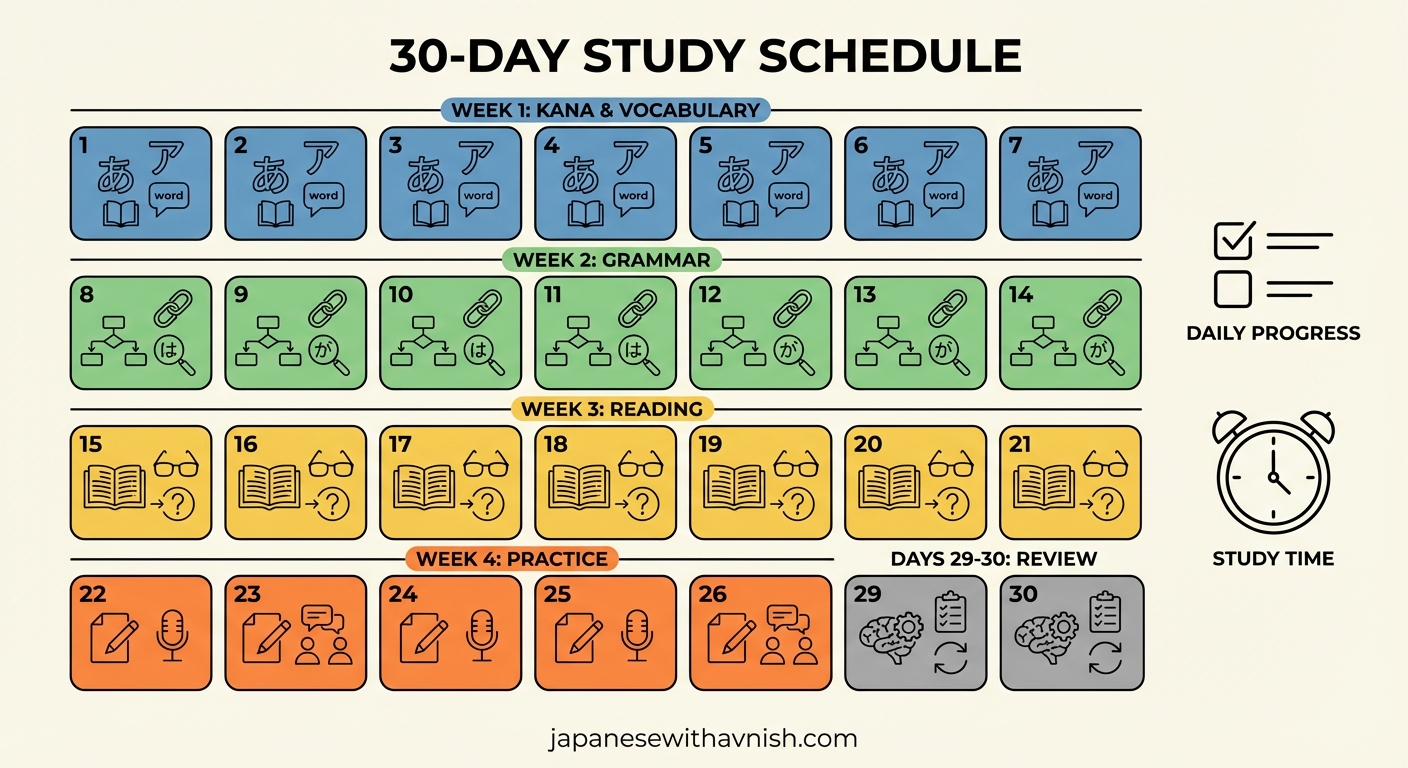 Here is your actionable day-by-day guide. Aim for 2-3 hours of focused study per day, broken into smaller sessions if needed.
Days 1-7: Foundation Week (Hiragana, Katakana, & Core Vocabulary)
- Day 1-2: Master Hiragana. Write each row, practice reading simple words.
- Day 3-4: Master Katakana. Focus on words borrowed from English.
- Day 5-7: Learn 100 core N5 nouns and adjectives. Use flashcards. Practice writing them in kana.
- Words to learn: 人 (ひと - person), 水 (みず - water), 大きい (おおきい - big), 新しい (あたらしい - new).
Days 8-14: Grammar Introduction & Verb Conjugation
- Day 8-10: Learn basic sentence structure (XはYです) and question words (何、どこ、誰、いつ).
- Day 11-14: Conquer verbs. Learn the dictionary form, ます-form (present/future), and ました-form (past) for Group I (う-verbs) and Group II (る-verbs).
- Example: 飲む (のむ - to drink) → 飲みます (I drink) → 飲みました (I drank).
Days 15-21: Grammar Deep Dive & Reading Practice
- Day 15-18: Study essential particles (を、に、で、へ) and possessive の. Practice making 5 sentences daily.
- Day 19-21: Introduce adjectives (い-adjectives & な-adjectives) and their negative/past forms. Start reading very short passages (2-3 sentences).
Days 22-28: Integration, Listening, & Mock Practice
- Day 22-24: Combine all grammar. Practice longer sentences. Learn common expressions and counters (人、本、枚).
- Day 25-26: Dedicated listening practice. Use past paper audio. Focus on identifying key info: time, place, object.
- Day 27-28: Take your first full-length practice test under timed conditions. Analyze mistakes thoroughly.
Days 29-30: Final Review & Mental Preparation
- Day 29: Review all weak areas from your mock test. Revisit tricky kanji and grammar points.
- Day 30: Light review only. Go through your vocabulary list. Relax, ensure logistics (test venue, ID) are ready. Get a good night's sleep.
Week 1-4 Focus & Strategy Overview
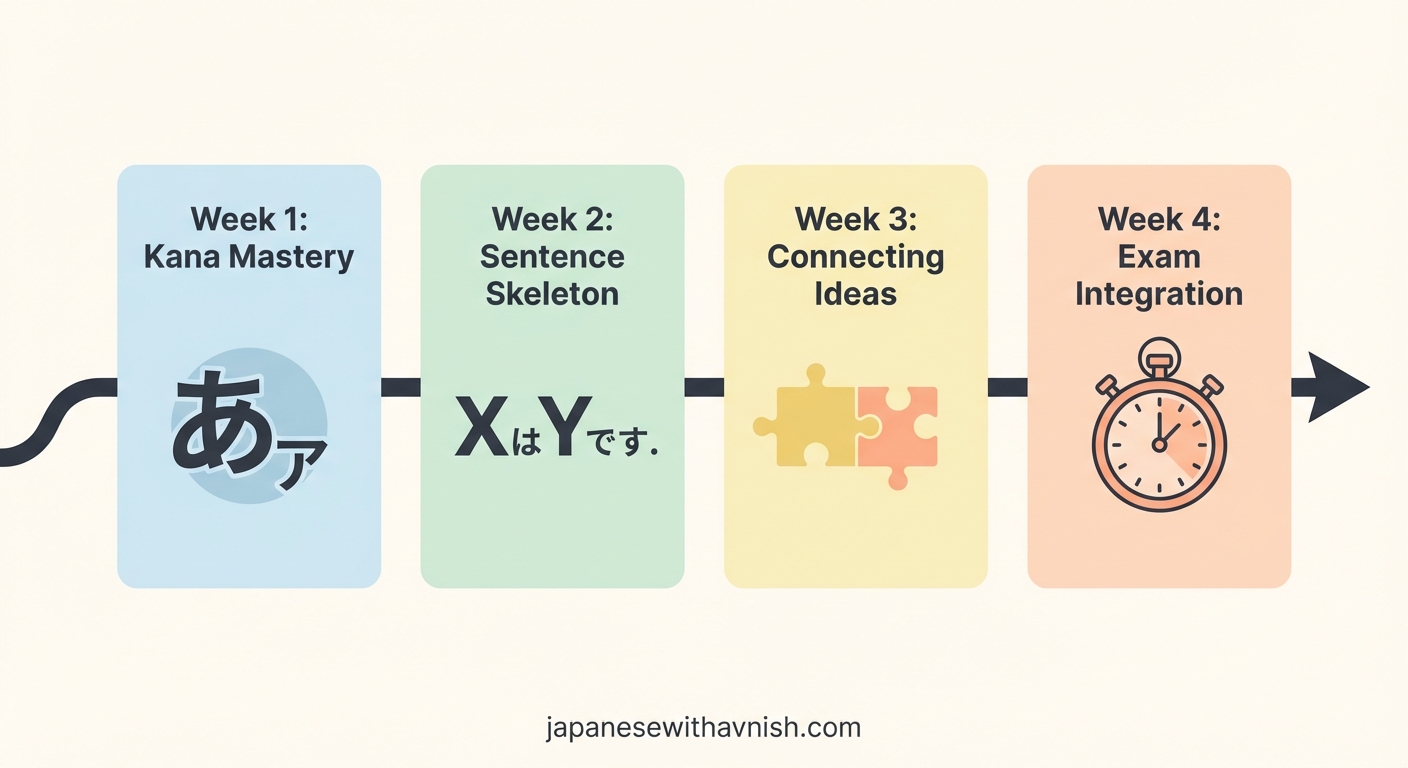
- Week 1 Goal: Achieve automatic recognition of Hiragana and Katakana. This is non-negotiable and will speed up all subsequent learning.
- Week 2 Goal: Understand the skeleton of Japanese sentences. Be comfortable creating simple statements and questions.
- Week 3 Goal: Build fluency in connecting ideas using particles and adjectives. Transition from recognizing words to understanding short texts.
- Week 4 Goal: Develop exam stamina and integrate all skills. The focus shifts from learning to applying and speeding up.
Essential Study Tips for Maximum Retention
- Write by Hand: The physical act of writing kana, kanji, and sentences creates muscle memory and deepens learning.
- Create Your Own Sentences: After learning a new grammar point, immediately create 2-3 original sentences. This is active recall.
- Example: After learning で (for means/place of action): 私はバスで大学へ行きます。 (I go to university by bus.)
- Shadow Listening: For listening practice, repeat phrases aloud immediately after hearing them. This improves pronunciation and processing speed.
- Use a Timer: Mimic exam conditions during practice sessions. Give yourself 25 minutes for a vocabulary drill, for instance.
- Review, Don't Just Preview: Dedicate at least 30% of your study time to reviewing previous days' material. Spaced repetition is key.
Recommended Resources for Your Journey
While there are many resources available, a structured, comprehensive system can streamline your preparation immensely. Our Japanese N5 Mastery Bundle is specifically designed for this purpose. It provides a curated path through all N5 requirements, integrating grammar lessons, vocabulary lists, kanji practice, and audio drills for listening into a coherent study system. This eliminates the guesswork of what to study next and ensures you cover every topic tested. For learners who see themselves continuing to N4 and beyond, the Complete Japanese N5-N1 Mega Bundle offers a seamless long-term learning path.
Explore our N5 Mastery Bundle for a structured study system that aligns perfectly with this 30-day plan.
Final Week Strategy and Exam Day Mindset
The final days are about consolidation, not cramming. Trust in the work you have done. During the exam, manage your time wisely: don't spend too long on any single question. For listening, mark your answer as soon as you hear it and immediately focus on the next question. Stay calm. Remember, N5 is a test of basic competence; you are demonstrating the foundation you have built.
This 30-day plan provides the framework, but your consistent effort is the engine. By following this day-wise guide, you are not just preparing for a test; you are establishing disciplined study habits that will serve you throughout your Japanese language journey. 頑張ってください (Ganbatte kudasai) – Please do your best.
If you prefer a structured, ready-made study system that integrates grammar, vocabulary, kanji, and listening practice into a clear daily routine, explore our Japanese N5 Mastery Bundle designed for focused and efficient learning.
Summary
This 30-day study plan provides a structured, day-by-day roadmap for learners aiming to pass the JLPT N5 exam. It transforms preparation from a daunting task into a manageable routine by breaking down the essential components—Vocabulary, Grammar, Reading, and Listening—into focused daily sessions. The guide emphasizes that success is achievable through consistency, balance, and active recall, advocating for daily practice over ineffective cramming. The plan begins with a clear overview of the 105-minute N5 exam structure, which consists of Language Knowledge (Vocabulary), Language Knowledge (Grammar) & Reading, and Listening sections. Understanding this format allows for targeted study. The core of the guide is a detailed four-week schedule. Week 1 focuses on mastering Hiragana and Katakana and learning core vocabulary. Week 2 introduces basic sentence structure and verb conjugations. Week 3 delves deeper into grammar, covering essential particles and adjectives, while incorporating initial reading practice. The final week is dedicated to skill integration, dedicated listening practice, and taking timed mock tests to build exam stamina. To maximize retention, the guide offers essential study tips: writing by hand to build muscle memory, creating original sentences for active recall, using shadowing techniques for listening, practicing with a timer, and dedicating significant time to review. It also recommends structured resources, like a dedicated N5 Mastery Bundle, to streamline preparation. The conclusion focuses on the final week's strategy and exam-day mindset, advising consolidation over cramming, trust in the completed work, and calm time management during the test. By following this disciplined framework, learners can build a solid foundation in Japanese and approach the exam with confidence.
What should you do next?
Recommended next reads
Best Books for JLPT N5: A Structured Guide for Your Foundation
A structured guide to the best textbooks, kanji, grammar, and practice books for JLPT N5. Build a solid foundation with our expert recommendations and study plan.
JLPT N5 Roadmap: Your Structured Guide to Success
A comprehensive, step-by-step guide to passing the JLPT N5. Covers exam structure, study plan, essential grammar, vocabulary, and kanji for beginners.
Comments
Add a comment
Recommended bundles for you
Structured study materials to accelerate your JLPT journey.