45 Day Plan for JLPT N4: A Day-by-Day Study Guide
45 Day Plan for JLPT N4: A Day-by-Day Study Guide
Preparing for the JLPT N4 can feel like a significant undertaking. You've mastered the basics of N5, and now the path to intermediate proficiency stretches ahead. The key to navigating this journey successfully is not just hard work, but structured, consistent effort. A clear, day-by-day plan transforms an overwhelming goal into a series of manageable, achievable tasks. This guide provides a comprehensive 45-day roadmap, designed to systematically build your grammar, vocabulary, kanji, and listening skills, ensuring you walk into the exam hall with confidence and calm preparedness.
Table of Contents
- Understanding the JLPT N4 Exam Structure
- The 45-Day Study Philosophy: Consistency Over Intensity
- Phase 1: Foundation Review & Grammar Core (Days 1-15)
- Phase 2: Vocabulary Expansion & Kanji Integration (Days 16-30)
- Phase 3: Practice, Listening & Final Review (Days 31-45)
- Essential Study Resources & Tools
- Final Week Strategy and Mindset
Understanding the JLPT N4 Exam Structure
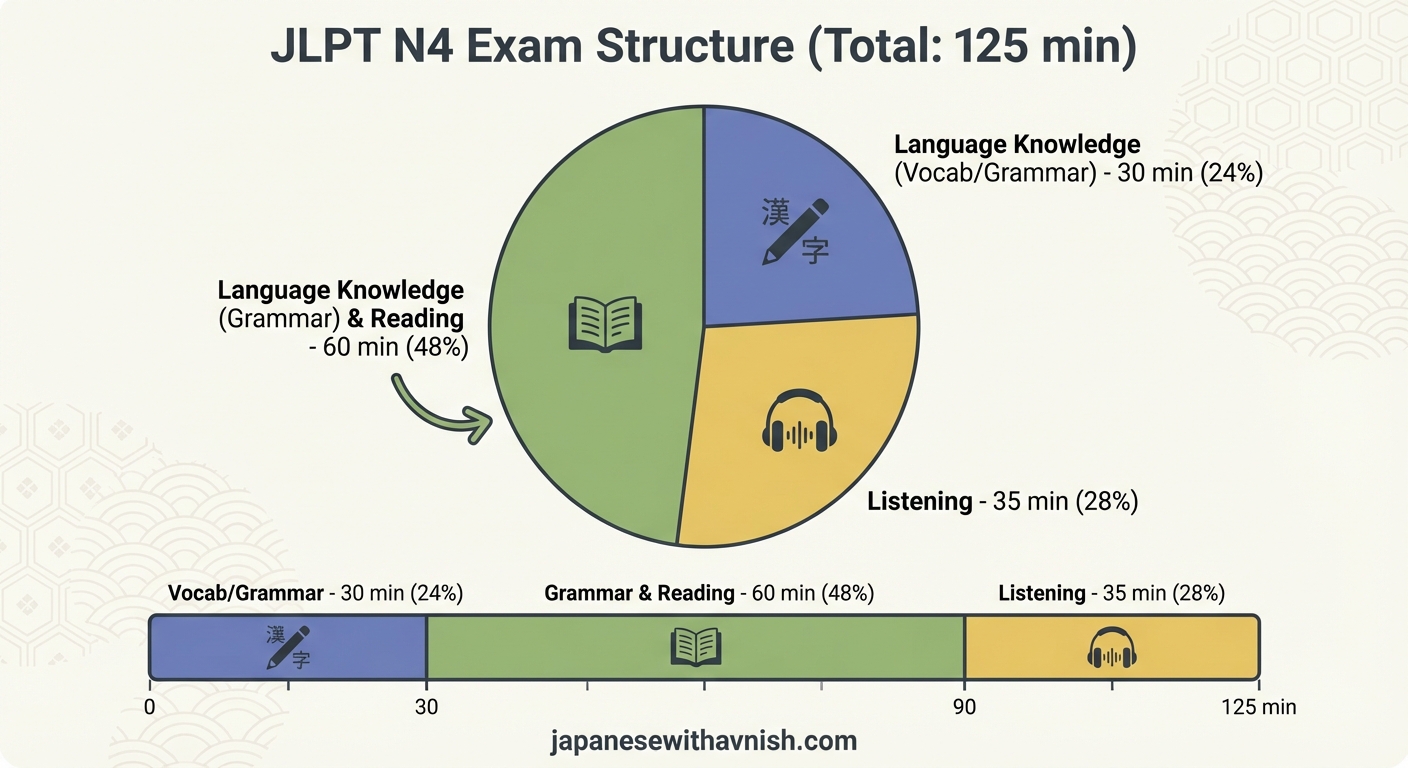 A strategic plan begins with understanding the battlefield. The JLPT N4 exam is divided into three sections, testing your ability to comprehend and use Japanese in everyday situations.
Language Knowledge (Vocabulary & Grammar) – 30 minutes: This section tests approximately 300 kanji and 1,500 vocabulary words. It includes kanji reading, orthography (correct word choice), word formation, and contextually-defined expressions.
Language Knowledge (Grammar) & Reading – 60 minutes: This combines grammar knowledge with reading comprehension. You will encounter tasks like selecting correct grammar forms, sentence composition, and understanding short to medium-length passages on everyday topics.
Listening – 35 minutes: This section evaluates your ability to follow conversations and narratives in daily life. Question types include task-based comprehension (understanding what to do based on a short talk), point comprehension (catching key details), and utterance expressions (choosing appropriate responses).
Knowing this breakdown allows you to allocate your study time proportionally, ensuring no skill is neglected.
The 45-Day Study Philosophy: Consistency Over Intensity
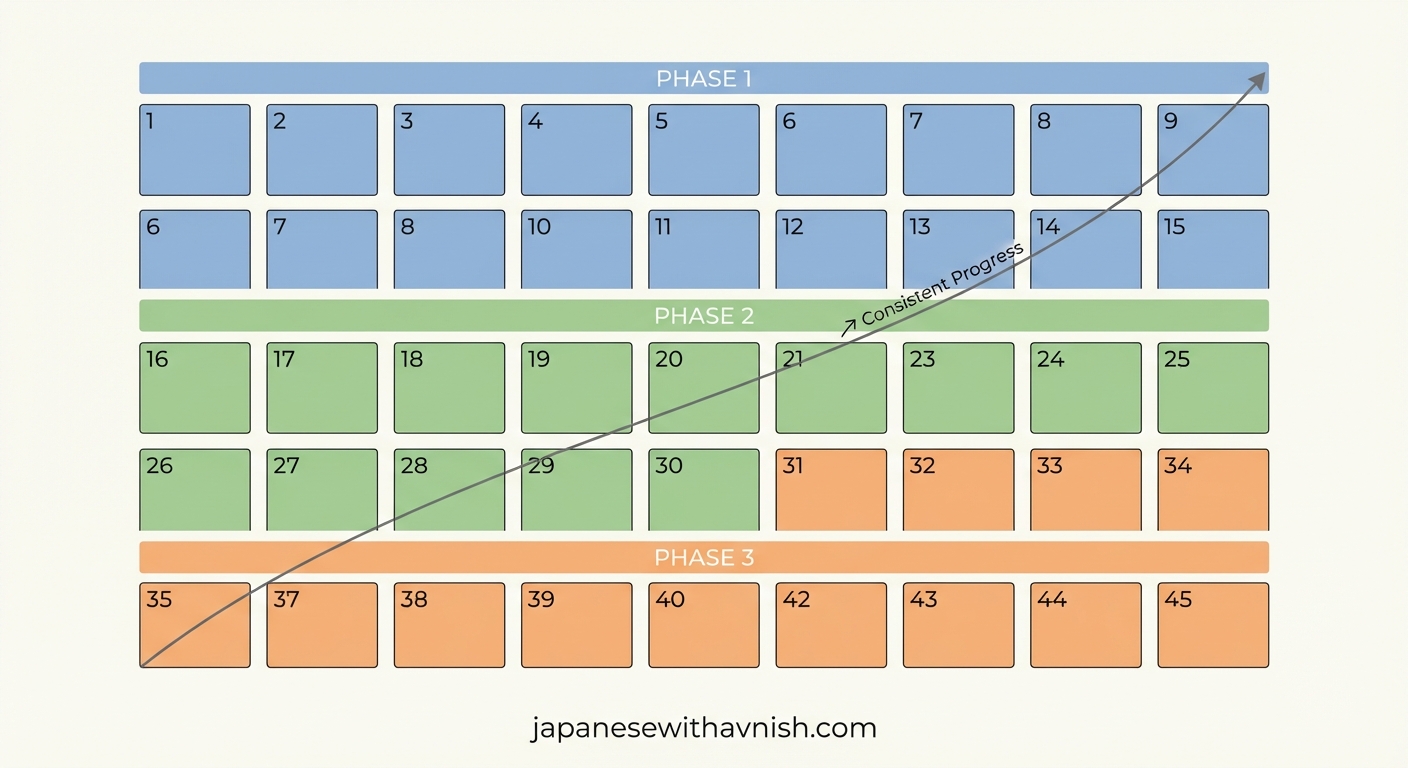 The most common pitfall in exam preparation is erratic studying—long, unsustainable cram sessions followed by burnout. The 45-day plan is built on the principle of daily, focused practice. Aim for 90-120 minutes of concentrated study each day. This consistent exposure is far more effective for language acquisition than sporadic, lengthy sessions. Your daily routine should include a mix of input (learning new material) and output (practicing what you've learned).
Phase 1: Foundation Review & Grammar Core (Days 1-15)
This phase solidifies your N5 foundation while introducing the core grammar patterns of N4. Do not rush this stage; a strong base is critical.
Days 1-5: N5 Review & Diagnostic
- Day 1-2: Review all N5 verb conjugations (ます-form, て-form, ない-form, dictionary form). Practice with sentences.
- Example: 食べます (I eat) → 食べて (eating/and eat) → 食べない (don't eat) → 食べる (to eat).
- Day 3-4: Review N5 adjectives (い-adjective and な-adjective) and basic particles (は、が、を、に、で).
- Day 5: Take a full N5 practice test or review section to identify lingering weak points.
Days 6-15: N4 Grammar Introduction
- Study 2-3 new grammar points per day. Focus on understanding the structure, meaning, and nuance.
- Key Grammar to Cover: Potential form (~られる、~える), なければならない (must), てみる (try doing), ながら (while), そうだ (hearsay/appearance), らしい (seems like), かもしれない (might), comparative and superlative forms.
- For each point, create 2-3 original sentences.
- Example for なければならない: 明日、レポートを出さなければならない。(I must submit the report tomorrow.)
- Use our Japanese N4 Upgrade Bundle for structured grammar lessons, example sentences, and audio drills that cement these patterns.
Phase 2: Vocabulary Expansion & Kanji Integration (Days 16-30)
With grammar frameworks in place, you now fill them with vocabulary and kanji. This phase is about building recognition and recall.
Days 16-25: Systematic Vocabulary & Kanji Study
- Learn 25-30 new words daily. Use flashcards (digital like Anki or physical). Focus on nouns, verbs, and adjectives common in daily life.
- Simultaneously, learn 5-7 new kanji per day. Don't just memorize the character; learn its common readings (onyomi and kunyomi) and key vocabulary it appears in.
- Example: Kanji 験 (test, examination). Onyomi: ケン. Vocabulary: 試験 (しけん - exam), 経験 (けいけん - experience).
- Pro Tip: Group vocabulary by theme (e.g., travel, shopping, health) to create stronger mental connections.
Days 26-30: Integration & Sentence Practice
- Stop learning only in isolation. Actively use your new vocabulary and kanji to form sentences using the grammar from Phase 1.
- Practice reading short paragraphs or dialogues that incorporate this week's material.
- Begin doing short, targeted practice questions for the "Language Knowledge" section.
Phase 3: Practice, Listening & Final Review (Days 31-45)
This final phase shifts from learning to application, honing your test-taking skills and building endurance.
Days 31-37: Focused Skill Practice
- Listening (Daily, 20-30 min): This is non-negotiable. Use past papers or dedicated listening resources. Listen actively, then with the script, then actively again.
- Example question type: Listen to a conversation at a station. "What time does the next train for Shinjuku leave?"
- Reading (Alternate Days): Practice reading comprehension passages. Time yourself. Learn to skim for main ideas and scan for specific details.
- Grammar/Vocab Drills: Continue with mixed practice questions to keep all material fresh.
Days 38-42: Full-Length Mock Exams
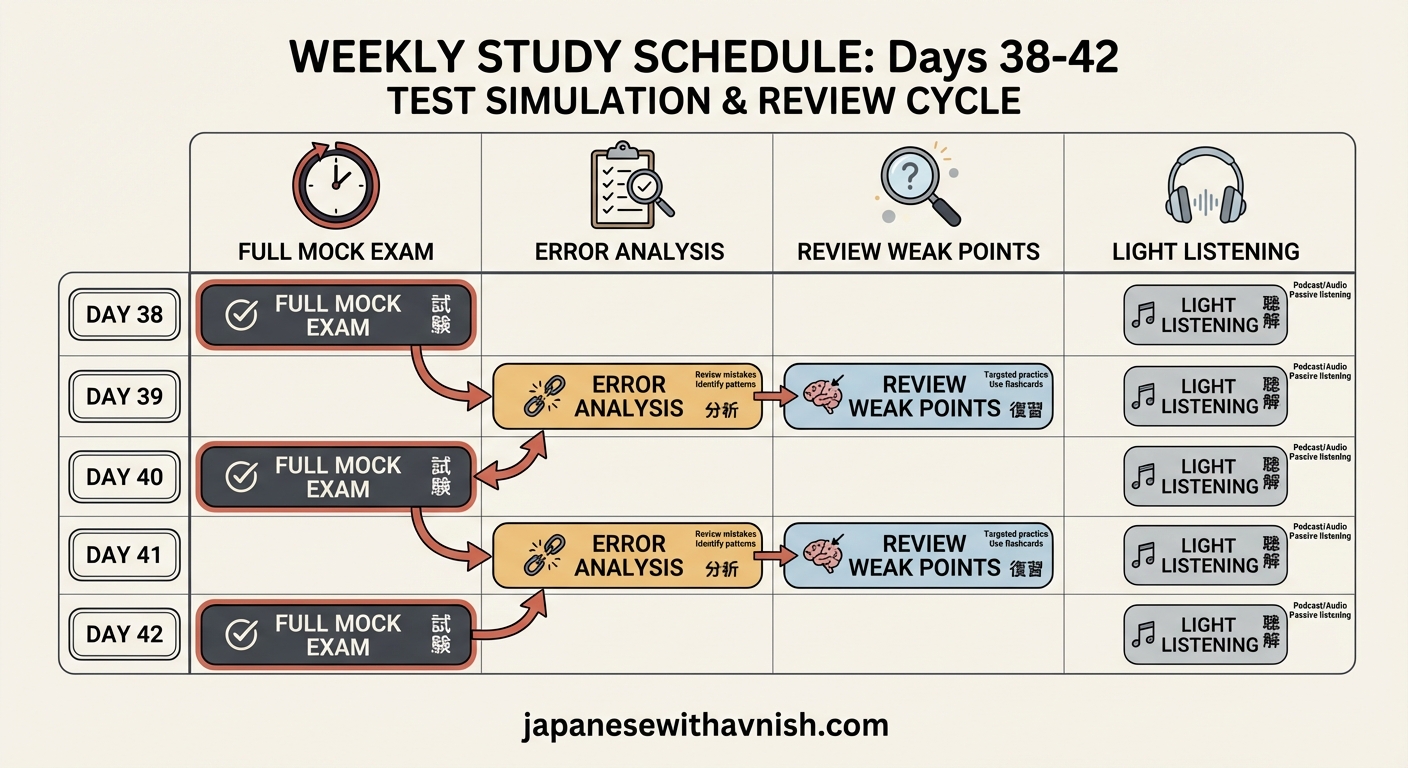
- Take 2-3 full, timed practice tests under exam conditions. This is the most critical part of your preparation.
- Process: 1) Take the test in one sitting. 2) Grade it strictly. 3) Analyze errors meticulously. Was it a vocabulary gap? Misunderstood grammar? Listening distraction? Note these in a dedicated error log.
- Our Complete Japanese N5-N1 Mega Bundle includes multiple full-length practice tests with detailed answer explanations, which are invaluable for this stage.
Days 43-45: Final Review & Mindset Preparation
- Do not learn new material. Review your error log, re-study weak grammar points, and revisit vocabulary/kanji you frequently forget.
- Light listening practice to keep your ear tuned.
- Organize your test-day materials (admission ticket, pencils, eraser, watch).
- Prioritize sleep, nutrition, and light relaxation. Your brain consolidates learning during rest.
Essential Study Resources & Tools
- Primary Textbook/Guide: A structured resource like "Shin Kanzen Master N4" or "Try! N4."
- Vocabulary/Kanki: Flashcards (Anki app) or a dedicated N4 vocabulary list.
- Listening: Official JLPT practice CDs, Japanese podcasts for beginners (like NHK Easy News), or listening sections from past papers.
- Practice Tests: Past papers or high-quality mock exams are essential.
- Structured System: For learners who prefer an integrated approach, our Japanese N4 Upgrade Bundle provides a coherent curriculum covering all these areas in one place.
Final Week Strategy and Mindset
In the final days, trust your preparation. Your goal is to execute calmly. On exam day, manage your time: don't linger too long on any single question in the Language Knowledge section. For Listening, mark your answer immediately after the question—there is no time for second-guessing. Remember, the JLPT is a test of practical, communicative competence you have been building for 45 days.
If you prefer a structured, ready-made study system that integrates grammar, vocabulary, kanji, listening drills, and practice tests into a coherent daily plan, explore our Japanese N4 Upgrade Bundle. It is designed to provide the clarity and guidance that turns disciplined effort into confident success.
Summary
This 45-day study guide provides a structured, day-by-day roadmap to prepare for the JLPT N4 exam, emphasizing consistent daily effort over intense cramming. The plan is divided into three focused phases, designed to build all necessary skills systematically. The first phase (Days 1-15) establishes a strong foundation. It begins with a review of key N5 concepts like verb conjugations and particles, followed by the systematic introduction of core N4 grammar points, such as the potential form and なければならない (must). Learners are encouraged to create original sentences to cement their understanding. The second phase (Days 16-30) focuses on vocabulary expansion and kanji integration. The guide recommends learning 25-30 new words and 5-7 new kanji daily, using flashcards and thematic grouping. The latter part of this phase stresses integrating this knowledge by forming sentences and practicing short reading passages to move beyond isolated memorization. The final phase (Days 31-45) shifts from learning to application. It involves daily listening practice, timed reading exercises, and, most crucially, taking 2-3 full-length mock exams under realistic conditions. The last few days are dedicated to reviewing errors, consolidating weak points, and preparing mentally for test day, with an emphasis on rest and organization. Throughout the plan, the guide underscores the importance of understanding the exam's structure—Language Knowledge (Vocabulary/Grammar), Reading, and Listening—to allocate study time effectively. It recommends essential resources like the "Shin Kanzen Master" series, Anki flashcards, and past papers, while also promoting a mindset of calm execution. The overarching philosophy is that disciplined, daily practice of 90-120 minutes is the most reliable path to walking into the exam hall with confidence.
What should you do next?
Recommended next reads

JLPT N4 Roadmap: Your Structured Guide to Success
A structured, step-by-step guide for JLPT N4 learners. Covers exam format, grammar, vocabulary, kanji, a 4-month study schedule, and test strategies for success.

Best Books for JLPT N4: A Structured Guide for Your Foundation
A calm, structured guide to the best textbooks, drill books, and practice tests for JLPT N4. Build a solid foundation with our expert resource recommendations and study plan.
Comments
Add a comment
Recommended bundles for you
Structured study materials to accelerate your JLPT journey.