Special Katakana Combinations: ファ, ティ, ドゥ
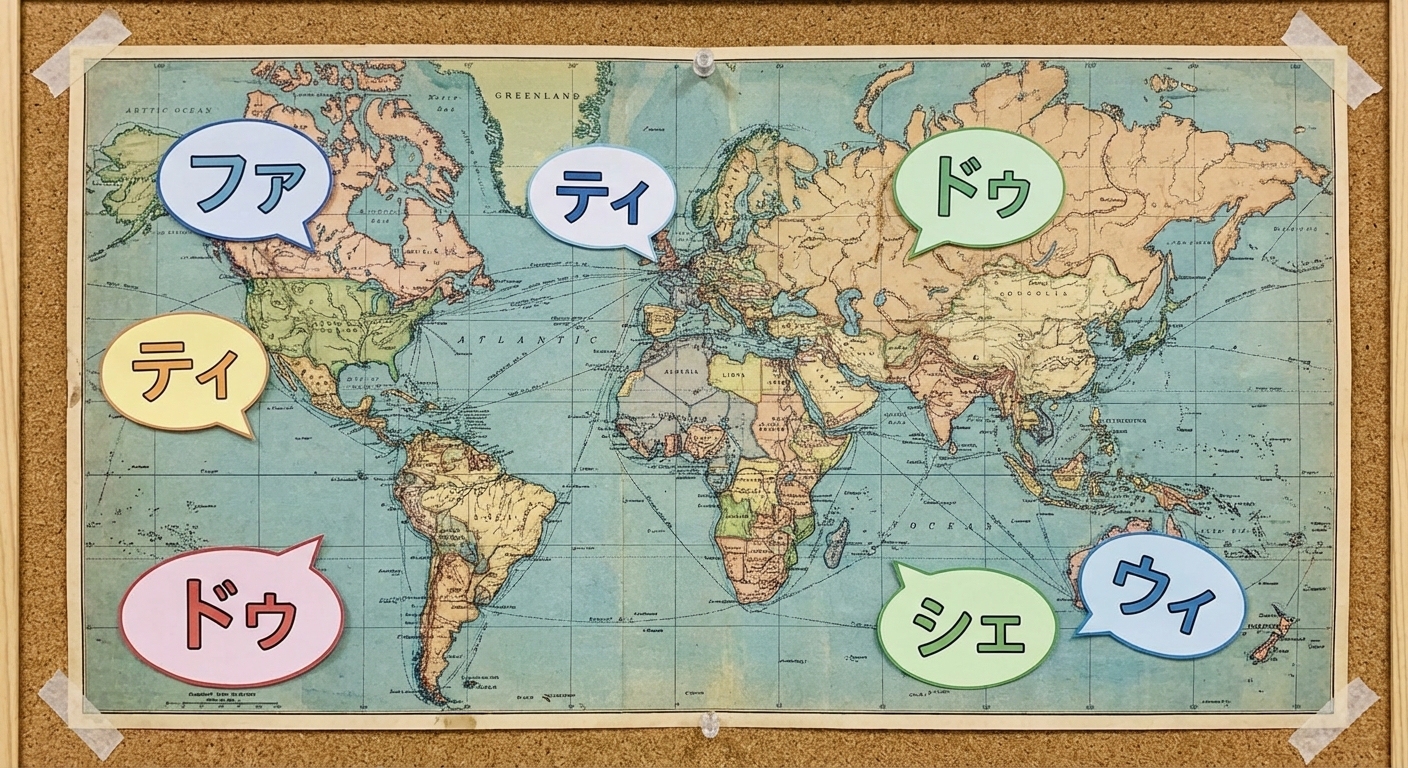
Characters
| Katakana | Romaji |
|---|---|
| ファ | fa |
| ティ | ti |
| ドゥ | du |
| ウィ | wi |
| チェ | che |
Special Katakana Combinations: ファ, ティ, ドゥ
Introduction
While the standard katakana syllabary covers native Japanese sounds, additional combinations are essential for accurately transcribing foreign loanwords. These special combinations approximate sounds that do not exist in traditional Japanese phonetics, such as "fa," "ti," and "du." Mastering them is crucial for reading and pronouncing modern imported terms correctly, from technology and brand names to food and cultural concepts.
Character Set
These sounds are created by combining a small version of a vowel kana (ャ, ィ, ゥ, ェ, ォ) with a standard katakana character to form a new, contracted sound.
| Combination | Romaji | Mnemonic / Sound Origin | Example Word (Meaning) |
|---|---|---|---|
| ファ | fa | Father. Small ァ attached to フ (fu). | ファックス fakkusu (fax) |
| フィ | fi | Feet. Small ィ attached to フ (fu). | フィルム firumu (film) |
| フェ | fe | Feather. Small ェ attached to フ (fu). | コーヒー kōhī (coffee) |
| フォ | fo | Fork. Small ォ attached to フ (fu). | フォーク fōku (fork) |
| ティ | ti | Tea (as in the drink). Small ィ attached to テ (te). | パーティー pātī (party) |
| ディ | di | Deep. Small ィ attached to デ (de). | デザイン dezain (design) |
| ドゥ | du | Do (as in musical note). Small ゥ attached to ド (do). | ドゥーワップ dūwappu (doo-wop music) |
Pronunciation Tips
- Mouth Position: For the ファ-row sounds (ファ, フィ, フェ, フォ), start with the lip position for the Japanese フ (fu)—where the upper teeth lightly touch the lower lip—but immediately transition to the following vowel sound without the strong "u" glide.
- Common Mistake: Avoid pronouncing ティ as "tee" (like テー) or ディ as "dee" (like デー). The small ィ creates a clipped, single-mora vowel sound closer to the English "ti" in "ticket" or "di" in "digital."
- Flow: These are single, unified sounds, not two separate syllables. Practice them as quick, single beats.
Practice
Read the following words aloud, focusing on the special katakana combinations.
-
ファミリー
famirī
family -
インターネット
intānetto
internet
(Note the small ッ for the double consonant 't'.) -
ディスク
disuku
disk
What should you do next?
Recommended next lessons
Hiragana あ-row (Vowels)
Learn the five foundational vowel sounds of Japanese: あ, い, う, え, お.
Read →
Hiragana か-row (K-sounds)
Master the 'k' consonant sounds combined with the five vowels.
Read →
Katakana ア-row (Vowels)
Learn the katakana vowel characters used primarily for foreign words.
Read →
Katakana カ-row (K-sounds)
Master the katakana 'k' consonant sounds for transcribing foreign vocabulary.
Read →
Minimal Pairs: ら vs. な (R vs. N)
Practice distinguishing and pronouncing the often-confused 'r' and 'n' sounds in Japanese.
Read →
Voiced Sounds: が-row (G-sounds)
Learn the voiced counterpart to the か-row, marked by dakuten (゛).
Read →Comments
Add a comment
Recommended bundles for you
Structured study materials to accelerate your JLPT journey.